
An EXW vs FCA comparison starts with the point at which the buyer takes responsibility for the equipment. A lower equipment price can leave more collection work outside the supplier's scope. Before comparing offers for pumps, valves or instruments, establish who will load the shipment, arrange export formalities and coordinate the next transport leg. The delivery abbreviation is useful only when the named place and the practical arrangements are clear.
This guide explains the buying questions behind those terms under Incoterms® 2020. It is intended for traders and project procurement teams evaluating equipment quotations, including orders collected by their own freight forwarder. The examples are illustrative enquiry situations, not completed Oillinko projects. Use the comparison to request a complete commercial scope, then have the parties responsible for the transaction confirm the final contract and applicable export requirements.
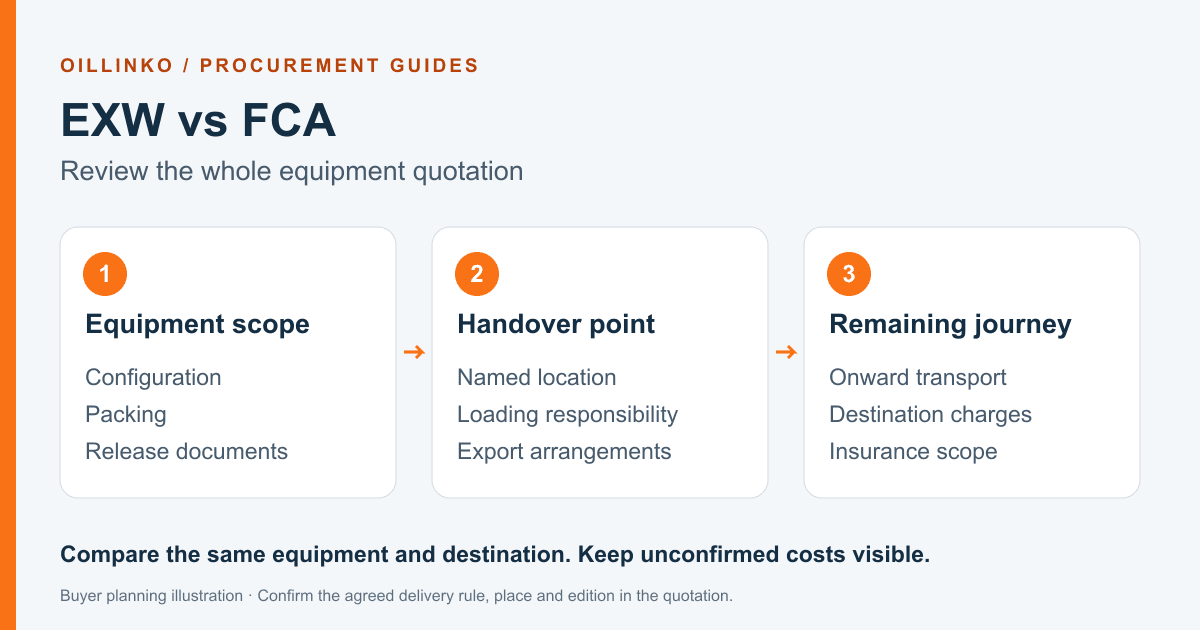
EXW vs FCA: what changes at handover?
Under EXW, or Ex Works, delivery normally occurs when the goods are placed at the buyer's disposal at the agreed point, without loading the collecting vehicle. Export clearance is the buyer's responsibility where applicable. ICC's EXW explanatory notes and rules also highlight loading risk: a supplier using its own forklift does not, by that fact alone, resolve who bears the risk during loading. Clarify any such arrangement expressly.
FCA, or Free Carrier, assigns export clearance to the seller. At the seller's premises, delivery occurs after loading onto the transport arranged by the buyer. At another agreed location, delivery occurs with the goods on the seller's arriving vehicle, ready for unloading and available to the nominated carrier or person. The ICC Academy comparison of EXW and FCA explains these two arrangements. Both rules can be used with different transport modes; the actual handover point matters more than whether the shipment eventually travels by sea, road or air.
Name an actual delivery point
Write the rule, precise location and edition together. An enquiry can request FCA at the supplier's dispatch warehouse, with the complete address and collection point to be confirmed, under Incoterms® 2020. Resolve those placeholders in the accepted quotation. A country name, city or port alone can leave several possible facilities in play. Ask which entrance or receiving area the carrier will use and which contact can confirm the collection appointment.
For example, consider a pump package offered FCA at a factory and another offered FCA at a forwarder's terminal. List the factory-to-terminal movement separately when comparing them. Check the terminal's unloading and receiving arrangements before booking the next leg. This recommendation follows from the different handover points; it does not mean that every terminal charge is included in a supplier's offer. Ask for inclusions and exclusions against the actual facility.
Compare the complete shipment scope
Build a comparison sheet around the same equipment configuration, quantity, delivery destination and readiness assumptions. Enter the supplier's quoted amount first, followed by each cost outside its scope. Obtain transport estimates using packed dimensions and gross weights. Record the date, currency and validity of each estimate, and leave unconfirmed charges visibly open. An empty cell should not silently become a zero when someone totals the offers.
Include collection handling, inland transport, export services where needed, onward freight, destination handling and final delivery in that review. Ask the responsible broker to assess duties and taxes for the specific goods and route. Separate confirmed prices from allowances. Keep insurance explicit too: neither EXW nor FCA obliges the seller to arrange cargo insurance for the buyer under the ICC rules' insurance provisions. Confirm the insured journey and handover with the insurance provider.
Payment, ownership transfer and remedies for late delivery need their own terms. The US International Trade Administration's explanation of what Incoterms cover distinguishes these matters from the delivery rules. In your bid comparison, give advance-payment requirements and quotation validity separate rows. A commercially acceptable delivery arrangement can still accompany a payment schedule that does not fit the purchasing company's approval process. Resolve both before issuing the order.
Specify packaging around the equipment
Ask the manufacturer to describe the proposed packing against the equipment and journey. For a valve order, request package identification that maps each crate to the valve list and any loose actuators or accessories. For instruments, identify separately packed mounting parts and documents. For a pump package, request the manufacturer's packed dimensions, handling information and storage requirements. These are different purchasing questions even when all three offers use the same delivery rule.
Explain whether the goods will move directly to installation or remain in storage. Ask the supplier to confirm the suitability and duration of its proposed protection, including any actions required during storage. Do not prescribe a generic preservation method from a shipping abbreviation. If the route changes, send the revised conditions back for review. Keep the approved packing description with the order so a later freight quotation refers to the same cargo arrangement.
Agree release and document responsibilities
Ask what the supplier means by ready: manufacture complete, inspection accepted, packed for collection, or released after payment. Put the required milestones on the same schedule. If the project requires a witnessed test or document review before dispatch, confirm the notice period and authorized release contact. The guide to third-party equipment inspection helps define those inspection responsibilities separately from transport booking. A carrier appointment is not evidence of technical acceptance.
Prepare a document register identifying each required record, its issuer and the date it is needed. Connect the packing list to purchase-order lines and package numbers; connect technical records to the supplied equipment. Request manufacturing origin independently of the dispatch address. A warehouse location does not establish the product's origin. For pressure components, the EN 10204 material-document guide explains why the specified inspection document and traceability need attention beyond the commercial invoice.
Confirm the export process with the seller and appointed logistics parties before accepting an EXW arrangement for an international order. ICC Academy recommends considering FCA where export responsibilities create difficulties for the buyer. The appropriate choice depends on what the parties can actually perform. Record who will provide the necessary product information, who will submit declarations and who will resolve missing documents. Avoid relying on an assumption that the forwarder will discover and fix every gap after collection.
Turn the comparison into a clear RFQ
Send suppliers one delivery brief alongside the technical equipment list. State your requested rule and named point, destination, required date, anticipated storage and documentation requirements. Invite suppliers to identify exceptions and price an alternative arrangement separately. Ask whether the lead time runs from order acceptance, payment or drawing approval. This makes a revised quotation easier to compare without changing the underlying technical requirement each time a transport option changes.
When several vendors are involved, review each purchase contract's handover before combining shipments. The article on multi-vendor shipment consolidation covers the broader coordination question. For an enquiry, use Oillinko's freight, expediting and project logistics requirements page, then send the equipment list and delivery brief. Requests come to Oillinko for manual review and coordination. The responding provider, available scope and commercial terms are confirmed for the particular requirement.
Frequently asked questions
Does an FCA quotation include delivery to our project site?
Only if that is the actual agreed FCA delivery place and the arrangement fits the rule. FCA at a supplier's factory does not include onward delivery to your site. Identify the precise handover point and price the remaining journey separately.
Is the country beside an FCA address the equipment's origin?
No. A dispatch warehouse or handover address does not establish where the product was manufactured. Request manufacturing origin and any required supporting documents separately for the supplied items.
Does changing EXW to FCA settle payment and warranty terms?
No. Record payment milestones, warranty scope, acceptance requirements and other commercial conditions separately. Ask the supplier for a revised written quotation showing the chosen rule, named place, edition and any agreed variations.