
Materials & Documentation
Connect each item to its evidence.
Read moreRead less about this category
Start with the product and its required evidence
Material certificates and equipment documentation help buyers connect a delivered item to the technical requirements of the purchase. This category focuses on material identification, inspection document types and traceability, rather than on the field activity of inspecting or repairing equipment. It supports the pressure components, fabricated equipment and other product families already represented in the Oillinko catalogue. A useful document request identifies the product, the applicable specification and the evidence needed for acceptance. A general instruction to supply certificates can leave all three questions unresolved.
The product specification and the inspection document have different roles. A material or product standard establishes relevant technical requirements, while an inspection document records information about conformity in the required form. A document type does not by itself choose the correct alloy, define the equipment design or establish suitability for a process fluid. The equipment selection guide addresses those application questions. Keep the technical selection and the documentary requirement aligned so the supplier understands both what must be supplied and what evidence must accompany it.
Specify the inspection document type
The EN 10204 article explains the inspection document types commonly referenced for metallic products. The BSI standard publication identifies EN 10204 and its scope. State the required type explicitly when the project calls for it, instead of relying on an informal phrase such as mill certificate. Different document types involve different information and validation arrangements. The requirement should come from the applicable contract and technical specification, rather than from a belief that every item needs the same certificate or that a more elaborate document always adds useful assurance.
Where the project requires specific inspection results, ask how the supplied product will be linked to those results. The relevant identity may be a heat, batch, serial number or another controlled identifier, depending on the product and specification. Establish which components of an assembly need individual material evidence. A complete equipment package can contain many materials, and a single certificate attached to the quotation may not cover them all. The supplier should state the document boundary so the purchaser can compare it with the actual acceptance requirements.
Preserve traceability through the supply route
Traceability is the connection between an item and the records that describe it. That connection can become unclear when goods are divided, repacked, machined or combined into assemblies. Ask how the supplier preserves the relevant identification through its scope of work. The receiving team should be able to connect package labels and product markings to the agreed records without guessing which certificate belongs to which line. If an item has limited marking space or a special identification method, agree how its identity will be maintained before production or shipment.
The seller's company name, manufacturer identity and actual manufacturing origin are separate facts. A supplier based in one country may offer equipment manufactured elsewhere, and dispatch location may differ again. If origin matters to the project, request confirmation for the specific item and the appropriate supporting document. Do not infer manufacturing origin from a company's headquarters or brand history. The supplier selection and RFQ category explains how to make these requirements visible in the enquiry and obtain a consistent response from each supplier being evaluated.
Review documents against the final order
Check that the document references correspond to the purchased material, product form and final specification. Identify the tests or properties the order requires and whether the records address them. A polished certificate layout or familiar logo does not establish that the information is applicable to the delivered item. Where a document is unclear or inconsistent, ask the issuing party or responsible supplier to clarify it through a traceable route. Retain the corrected version and its relationship to the earlier record rather than silently replacing information without a revision trail.
Document review should also distinguish a supplier declaration, a test report, an inspection certificate and a product approval. These forms of evidence can complement each other, but they are not interchangeable. A management system certificate concerns the stated organizational scope; a product test report concerns the tested item or configuration under its stated conditions. The inspection and material quality guide explains these boundaries. The buyer should request evidence that answers the acceptance question, not simply the largest possible collection of documents containing recognizable standard numbers.
Plan independent validation where required
If the project requires an appointed inspector or purchaser representative to validate particular evidence, arrange that involvement early. The scope may involve attendance, review or another defined activity, and the required independence or authority should be established before work progresses. The third-party inspection article provides context for planning witness and review points. A late request for an additional signature does not automatically create the evidence that would have been available from a properly planned inspection at the relevant manufacturing stage.
Specify who can accept document deviations and what must be resolved before dispatch. Some omissions may prevent technical release, while other records may be contractually agreed for later submission. The distinction needs a written basis rather than an informal assumption by the shipping team. Connect the document schedule to the logistics and delivery plan, so cargo readiness and technical acceptance are coordinated. Commercial shipping documents and material records serve different purposes, and completion of one package does not prove completion of the other.
Build a maintainable handover package
Organize the final records around purchase order lines, equipment tags or another identifier that the receiving and maintenance teams actually use. Include the accepted specification revision and resolved deviations where required. For spare parts, retain the relevant equipment reference so the record remains useful after the original packaging is removed. The quality enquiry page provides a route to discuss documentation requirements with Oillinko. State the expected document types and traceability basis in the initial request, allowing the proposed supplier to confirm the available evidence before the purchase becomes a commitment.
Match delivered material to its records
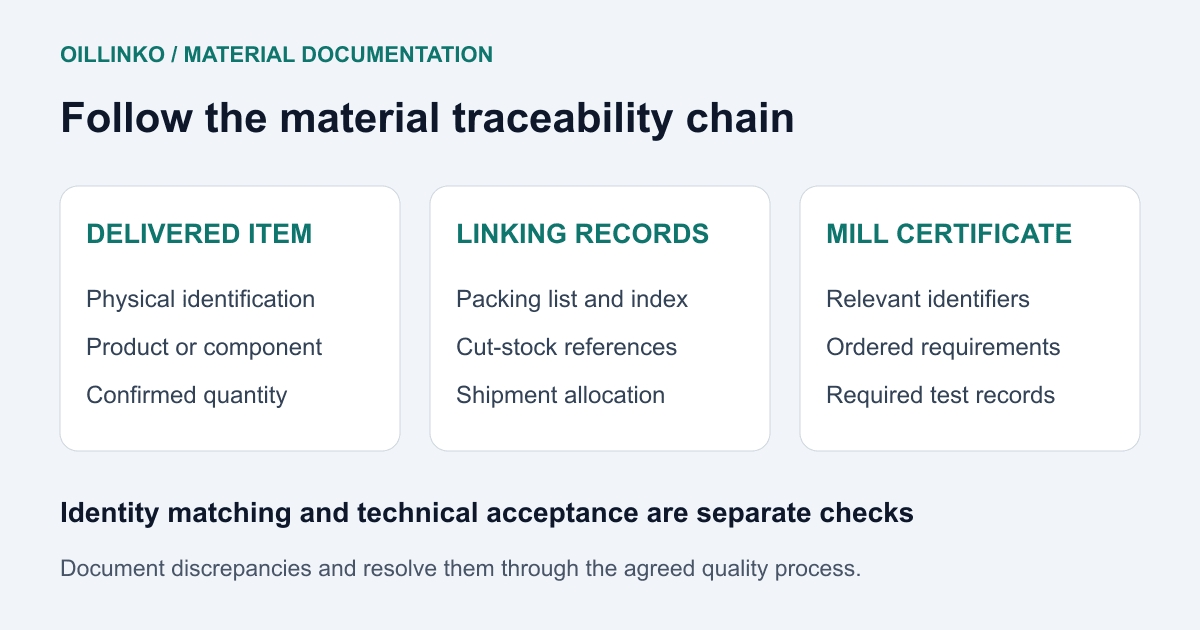
The heat number traceability guide follows the connection from physical identification through packing records to the relevant mill certificate. It explains questions to resolve for cut stock, split deliveries and component records, and separates a successful identity match from technical acceptance against the purchase specification.
Articles in Materials & Documentation
· 8 min read
Heat Number Traceability: Matching Materials to Mill Certificates
Connect delivered materials to their mill certificates and resolve gaps in the documentary chain.
Read article →

· 6 min read
EN 10204 Material Certificates Explained (2.1, 2.2, 3.1, 3.2)
The difference between a 3.1 and a 3.2 certificate — and when you need one
Read article →