
Supplier Selection & RFQs
Ask the right supplier the right questions.
Read moreRead less about this category
Decide what kind of supplier the requirement needs
Supplier selection for oil and gas equipment begins with the requirement's technical scope and commercial constraints. A manufacturer, distributor and sourcing company can each play a useful role, but their responsibilities and evidence differ. This category focuses on supplier fit, enquiry preparation and quotation comparison. It supports buyers working with a single replacement part or a mixed project list. The purpose is to identify who can credibly respond to the actual requirement, rather than sending the same incomplete enquiry to the largest possible number of companies.
For an exact replacement, access to the original product identification and the manufacturer's current ordering information may be central. For a fabricated item, production capability and the required inspection scope may matter more. For a multi-vendor order, coordination can be a separate need alongside product supply. The article on what an equipment sourcing partner does explains those coordination tasks. Ask each potential supplier to describe its role in the proposed transaction and identify any activities carried out by another party.
Prepare the information needed for a useful response
An RFQ should identify the item, quantity, unit and technical basis clearly enough for the supplier to decide whether it fits their scope. Include relevant datasheets, drawings and manufacturer codes, with revisions where applicable. Mark whether the requirement is for a complete assembly, an individual component or a kit. A short model name may omit options that affect compatibility or price. For a service, define the asset, location, desired result and client-provided inputs rather than treating the service name as a complete description of the work.
The bill of quantities article explains how to structure line items without mixing quantities, units and accessories. Keep technical attachments aligned with the schedule and identify which requirements apply across the order. State whether alternatives are acceptable and how deviations should be presented. If a detail is unknown, list it as a clarification rather than inserting an assumption. This helps suppliers explain what they need to complete the offer, and it prevents an early budget enquiry from becoming an accidental specification for an unsuitable product.
Verify fit before discussing an attractive price
Ask for product-specific evidence of capability and supply route. Depending on the item, this can include manufacturer identification, relevant product literature, drawings or confirmation of the proposed configuration. An unfamiliar company may still be capable, while a familiar brand name may appear on an offer from an unrelated seller. The article on evaluating an equipment trading company explains practical questions about identity, documentation and responsibility. Evaluate the evidence against the particular order rather than treating a professional website as proof of product suitability.
Do not infer stock availability from a catalogue listing. Ask where the goods are held, which exact configuration is available and what documentary evidence accompanies it. If the item is made to order, clarify the lead-time basis and dependencies. For discontinued products, request the manufacturer's replacement recommendation and a clear list of differences. The equipment selection category provides the technical context for these questions. An equivalent offered at a lower price still needs the responsible engineer's review of fit, function and applicable project requirements.
Compare quotations on a common basis
Build the comparison around the final requirement and the supplier's written exceptions. Identify whether price includes accessories, tests, documents, packing and any service activities. Separate optional items from mandatory scope. Commercial terms should identify currency, validity, payment conditions and delivery responsibilities, with the named location where appropriate. An offer that excludes freight or inspection may still be useful, but the excluded cost must be understood before comparing the completed purchase. Avoid ranking offers by a single headline number when their supply boundaries differ.
The article on why RFQs reach the wrong supplier explains common mismatches in specialization and capability. Use the clarification process to resolve those mismatches early. If the required standard or manufacturing origin cannot be met, ask the supplier to say so explicitly. Country of manufacture, supplier headquarters and shipment location are different facts. Record the origin requirement separately from delivery destination and request confirmation tied to the offered item. A company's address does not establish where a particular product will be made.
Keep approvals and supplier communication traceable
Technical clarifications can change price and lead time, so retain the accepted responses with the quotation. Identify who can approve an alternative, revise a quantity or accept a deviation. If several suppliers are being compared, issue material changes consistently so their final offers address the same scope. Avoid creating a purchase order from a mixture of an old datasheet and a later informal message. A clear revision trail makes the receiving and acceptance process easier because the delivered item can be checked against an agreed final description.
Inspection, certification and warranty obligations should also be agreed before placement. The inspection and material quality category helps define the evidence required, while logistics and delivery covers readiness and shipment coordination. Where a claim relies on a manufacturer's warranty or authorization, ask for the applicable terms and confirmation of the supply route. Do not assume that every reseller's offer carries identical manufacturer support. The commercial agreement should identify the actual party responsible for addressing a nonconformity or warranty issue.
Route the enquiry through Oillinko
Oillinko receives requirements for sourcing and RFQ coordination through the procurement services page and enquiry form. Provide the current equipment list, supporting specifications and the date by which a response is needed. State whether the enquiry is budgetary or intended for near-term purchase. The comparison of direct manufacturer and trading-company purchasing can help choose the commercial route. Product availability, supply scope and commercial terms are confirmed through the individual offer, while the buyer retains control of the technical and purchasing approvals required for the order.
Agree inspection participation before ordering
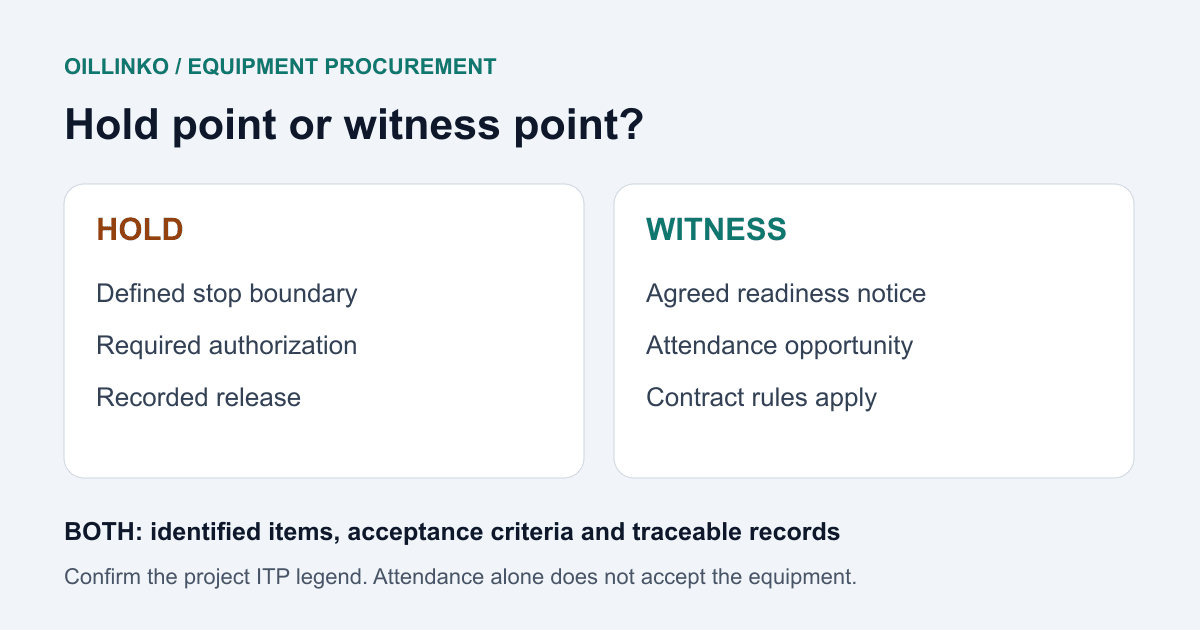
The inspection and test plan guide explains how hold and witness points affect notices, attendance and release authority. Use it when comparing inspection commitments in equipment offers, especially where different parties must review records or approve progression through manufacturing stages.
Articles in Supplier Selection & RFQs
· 9 min read
Inspection and Test Plans: Hold vs Witness Points
Agree inspection participation, notification and release authority before placing an equipment order.
Read article →

· 8 min read
Common Reasons an RFQ Goes to the Wrong Supplier — and How a Sourcing Partner Filters for Fit
Why RFQs land on mismatched suppliers, and how to filter for real fit before sending one
Read article →
· 8 min read
How to Evaluate and Vet an Equipment Trading Company Before You Send Your First RFQ
The checks that separate a real sourcing partner from a reseller with a PDF catalogue
Read article →
· 8 min read
Equipment Trading Companies vs Buying Direct from the Manufacturer: Pros, Cons and When Each Makes Sense
The trade-offs between routing an order through a trading company and buying direct from the factory
Read article →

· 8 min read
What an Oil & Gas Equipment Sourcing Partner Actually Does (Beyond Placing the Order)
Vendor vetting, comparable quotes, technical review, inspection coordination and freight — the work behind the RFQ
Read article →

· 6 min read
How to Write a Bill of Quantities (BOQ)
Get your equipment list right so suppliers can quote
Read article →