
Piping, Flanges & Fittings
Industrial Hose Assembly RFQs: Service, End Connections and Traceability
A buyer checklist for comparing the entire flexible connection rather than a bare hose price.
By OillinkoPublished Updated 8 min read
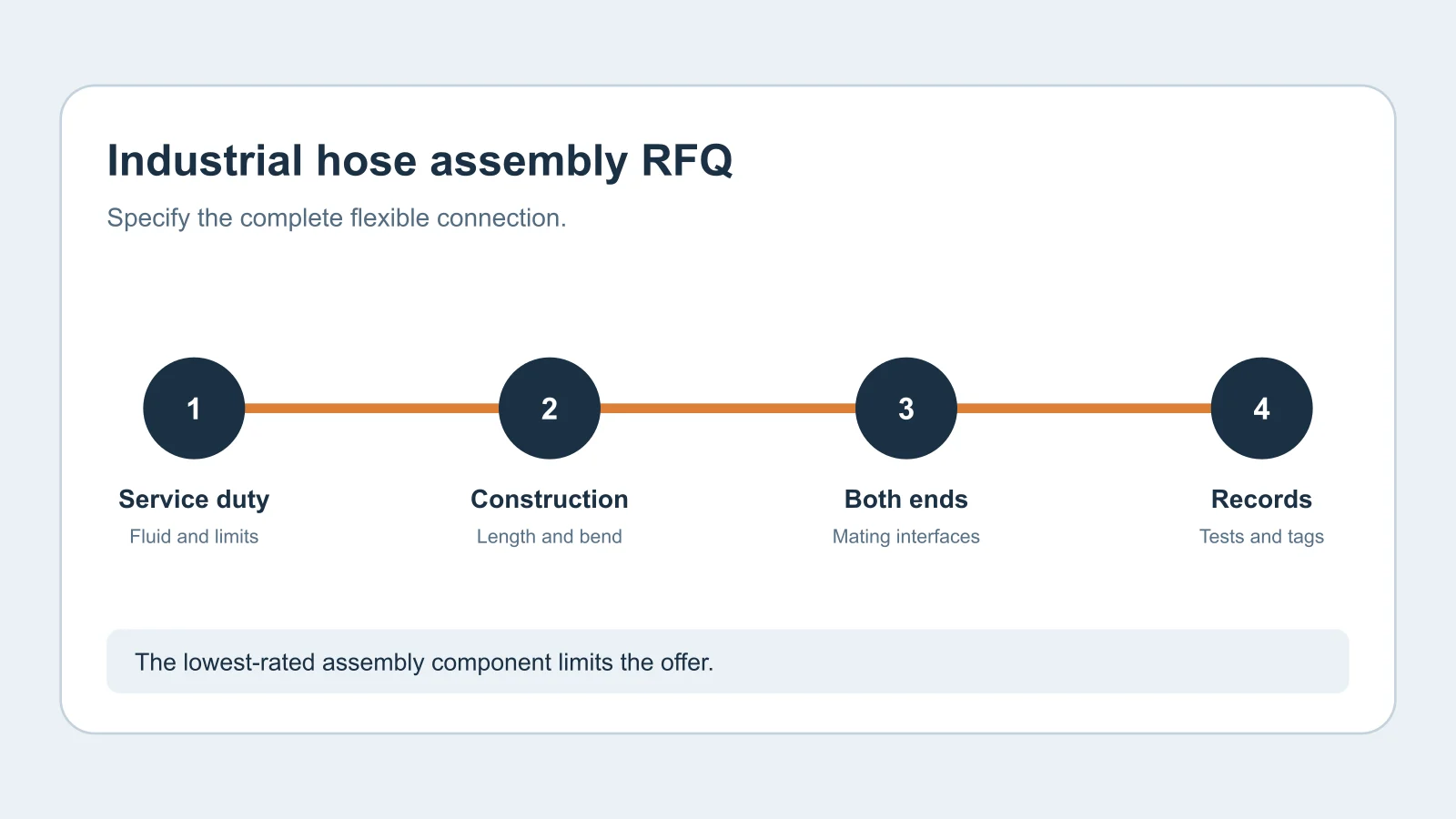
An enquiry for a two-inch flexible hose can produce offers that look comparable on a spreadsheet but are different assemblies. One quotation may cover a bare hose, another a factory-terminated assembly, and a third an assembly with testing and identification records. The buyer needs to describe the fluid, operating envelope, installation and both mating connections before comparing price. The governing requirement is suitability of the complete assembly, including hose, fittings and any attachments, for the defined duty.
A hose and fittings manufacturer catalogue treats pressure, fluid compatibility, temperature, bend radius and end selection as connected choices. Its ratings belong to the particular listed products; they are not a universal rating for every industrial hose. Use such information to frame questions and require the bidder to declare the actual offered assembly and its limits.
State the actual service envelope
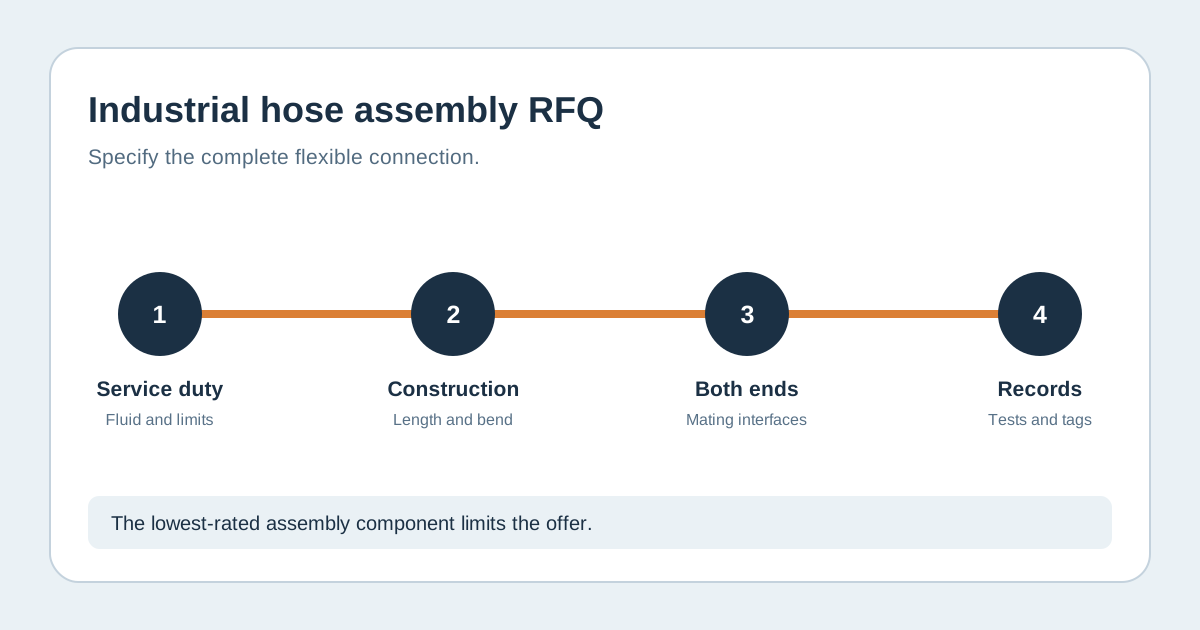
Identify the conveyed medium, concentration where relevant, expected contamination and whether the service is liquid, gas or multiphase. Give the normal and maximum operating pressures, temperature range, any vacuum condition, and credible pressure surges known to the project engineer. State the required design or test basis from the project specification. A nominal working pressure without the applicable temperature and medium can be misleading because hose construction and fittings may have different limitations. Ask suppliers to identify the lowest rated component in their proposed assembly.
Describe the location as well as the process. An indoor static transfer line has different external exposure from a moving connection on a skid, dock or marine installation. State whether weather, UV, abrasion, splash, vibration, electrical continuity or fire performance is a specified requirement. Avoid assuming that a product advertised as marine or chemical hose is suitable for every marine or chemical duty. The bidder should declare the construction, compatibility basis and any service exclusions, while the responsible engineer approves the final specification.
Define the installed geometry and movement
Give the required overall length and explain how it is measured: end-to-end between sealing faces, between fitting shoulders, or as a cut hose length. Supply a sketch showing both fixed connection locations, normal and extreme equipment positions, nearby obstructions, support points and expected movement. The installed bend radius must remain within the limits of the offered assembly through the movement envelope. A hose drawn as a straight line between two nozzles may be too short once fitting lengths and a safe bend are considered.
Ask whether the hose needs strain relief, abrasion sleeves, guards, restraints or lifting support, and distinguish an engineered requirement from an optional accessory. A heavy assembly can impose loads on small nozzles if it is left unsupported. If torsion or repeated movement is expected, describe it rather than letting each supplier assume a static installation. The quotation should show the proposed route and explain any clearance or support condition on which its suitability depends.
Specify both ends without shorthand
List each end separately, including connection standard, nominal size, pressure class or thread form, material, sealing face, orientation and any required swivel or adapter. An end described only as a two-inch flange is incomplete. Include mating-nozzle drawings or verified dimensions when a replacement must fit existing equipment. Ask whether gaskets, bolts, caps, adapters and reducers are included. If one supplier includes them and another excludes them, the apparent price difference says little about the landed, installable package.
Request a general assembly drawing or dimensioned data sheet identifying hose type, reinforcement, liner, outer cover, fittings, overall length and minimum bend radius. Ask the bidder to state whether the proposed end fitting is part of an approved hose-and-fitting combination and how the assembly is made and checked. Do not mix a hose rating from one catalogue with an unrelated fitting rating to infer a complete-assembly pressure capability.
Make acceptance and traceability visible
Specify the identification to be marked on each assembly: project tag, manufacturer or assembler reference, size, relevant pressure rating, date or batch as required, and a link to the corresponding records. Request the assembly test procedure and report if testing is required, including test medium, pressure, duration, acceptance criterion and the serial or tag number tested. These values must come from the approved project requirement and the applicable assembly standard; a generic internet checklist is not an acceptance procedure.
Clarify whether material certificates are needed for pressure-retaining fittings, whether a certificate of conformity is sufficient for other components, and how the documentation will connect to the finished hose. Ask about preservation, protective caps, packing and the handling conditions before shipment. A test sheet for an unidentified sample does not prove that the hose delivered to the site was the one tested. The material traceability guide explains the broader link between an item and its evidence.
Compare offers on a common basis
Create bid columns for duty, hose construction, complete-assembly rating, length basis, each end connection, minimum bend radius, included accessories, test records, origin, lead time and exceptions. Ask each bidder to name missing design inputs rather than silently filling them in. Compare alternatives only after documenting their technical effect and the approval route. The origin and dispatch guide helps keep manufacturing origin distinct from shipping location. Send the approved duty and interface information through Oillinko's industrial hoses and expansion joints page for manual supplier routing. A catalogue listing is an enquiry path, not evidence of available stock or project qualification.