
Wellhead & Production Equipment
Define the well equipment boundary.
Read moreRead less about this category
Identify the assembly before selecting a component
Wellhead and production equipment enquiries often begin with a component description, but the component belongs to an assembly with defined mechanical and pressure boundaries. This category covers the wellhead, tree, associated valves, chokes and production equipment represented in the Oillinko catalogue. Its purpose is to help buyers collect identification and project information for a qualified supplier review. It does not provide a well control procedure or establish that a proposed part can be installed on an operating well. Those decisions remain with the responsible operator and competent engineering personnel.
Start by identifying whether the requirement concerns a complete new assembly, a replacement component or a spare for a known installed configuration. Provide manufacturer, model, serial number, equipment tag and relevant drawings. A field description such as tree valve can leave the connection arrangement, pressure rating and internal construction unclear. Photographs of the nameplate and available markings can help resolve identification, but the supplier should confirm the full ordering description. If the original records are missing, identify that gap rather than filling it with an assumed standard or material grade.
Separate operating conditions from equipment ratings
The process and well design information should establish the pressures, temperatures and fluids the equipment will encounter. Gas, liquid, solids and corrosive constituents can change the materials and sealing questions that need to be assessed. Normal operating conditions and the design envelope are different inputs, and both should be clearly labeled. A manufacturer's maximum catalogue rating is not a recommendation to operate every configuration at that value. Ask the supplier to identify which offered assembly and components support the required conditions, with explicit exceptions where information is incomplete.
Material selection for sour production environments requires particular attention to the specified service conditions and material limitations. ISO 15156-1 addresses general principles for selecting cracking-resistant materials in hydrogen-sulfide-containing oil and gas production environments. It does not make every stainless alloy or every product bearing a sour service description suitable for all such conditions. Provide the applicable project materials specification and environmental information for review. Any statement of compliance should identify the actual material, product configuration and relevant supporting evidence rather than relying on an unqualified catalogue claim.
Check connections and interchangeability
Flanges, hubs, threaded connections and proprietary interfaces must be identified precisely. Matching a nominal bore does not establish that components from different assemblies will connect or perform correctly. Include connection drawings and any constraints imposed by the installed equipment. Consider the surrounding envelope, access and instrumentation connections as part of the enquiry. The wellhead and Christmas tree article introduces the assembly vocabulary, making it easier to distinguish a complete wellhead package from individual tree components when preparing a bill of quantities.
For spare parts, ask whether the proposed item is supplied by the original manufacturer or offered as an alternative. If alternatives are permitted, require an explicit engineering review of fit, material and performance requirements. Seals, trim, stems and other internal parts may be configuration-specific even where an external housing looks familiar. Identify whether installation instructions, specialist tools or additional replacement parts are required. Keep the operator's acceptance separate from the supplier's commercial willingness to quote, because a price and lead time do not demonstrate assembly compatibility.
Define the product specification and evidence
Well equipment specifications can distinguish temperature classes, material requirements, product specification levels and performance validation expectations. These are purchasing and engineering inputs, not labels to infer from an item photograph. The project should state which requirements and editions apply and which documents are needed to demonstrate conformity. A supplier should return a clear compliance and deviation statement for the offered configuration. Where manufacturer authorization or product licensing is required, check the scope of the actual credential and its relevance to the product; do not interpret a general quality certificate as universal product approval.
The materials and documentation guide explains how to specify traceability records for pressure-containing components and associated parts. Identify the required relationship between serial numbers, material batches and test reports. Ask which records accompany a replacement component and which belong to the original assembly. For existing equipment, retained inspection or service history may also be relevant to the purchase decision. A document package should answer the project's acceptance questions, rather than simply accumulating certificates whose relationship to the delivered item cannot be demonstrated.
Keep equipment supply and field work distinct
A new component quotation does not automatically include removal, installation, pressure testing or return to service. These activities require a separately defined scope, suitable personnel, site arrangements and approved procedures. The well construction and intervention services catalogue provides a place to describe such requirements for review. State the worksite, timing, equipment identification and expected deliverables. Explain which activities the operator performs and which a service provider would be expected to undertake, so the resulting offers can be compared on the same basis.
Prepare the final enquiry with line-item quantities, complete identification, specification documents and the requested delivery destination. Clarify whether the item is an operational spare, an urgent replacement or part of a planned new installation. Ask about preservation, storage instructions, available documentation and manufacturer support for the offered item. The wellhead and production equipment catalogue routes the enquiry to Oillinko for sourcing review. Supply availability, product suitability and any service scope are then confirmed for the particular requirement, rather than implied by inclusion in this educational category.
Articles in Wellhead & Production Equipment
· 9 min read
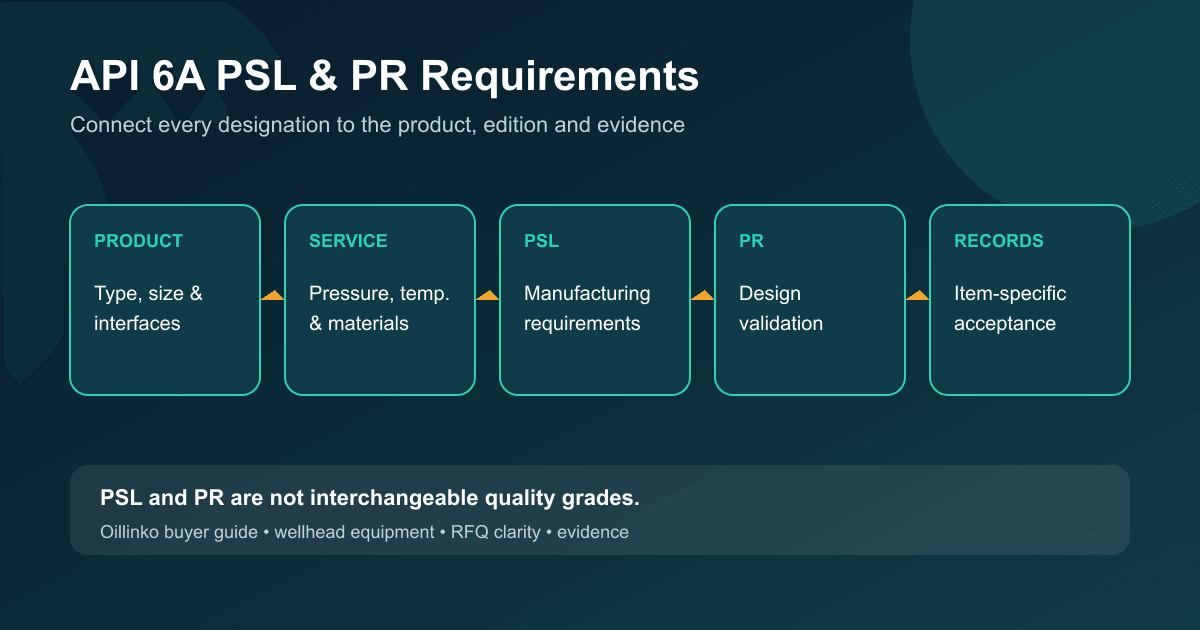
API 6A PSL and PR Levels: A Wellhead Equipment Buyer’s Guide
Separate product specification requirements from design-validation evidence before ordering wellhead and tree equipment.
Read article →

· 7 min read
Wellhead & Christmas Tree Equipment Explained (API 6A)
How wellhead pressure and material classes are set, in plain terms
Read article →