
Supplier Selection & RFQs
Pipeline Pre-commissioning Service RFQs: Scope, Boundaries and Handover
A service list becomes a comparable quotation only when responsibilities and acceptance records are visible.
By OillinkoPublished Updated 10 min read
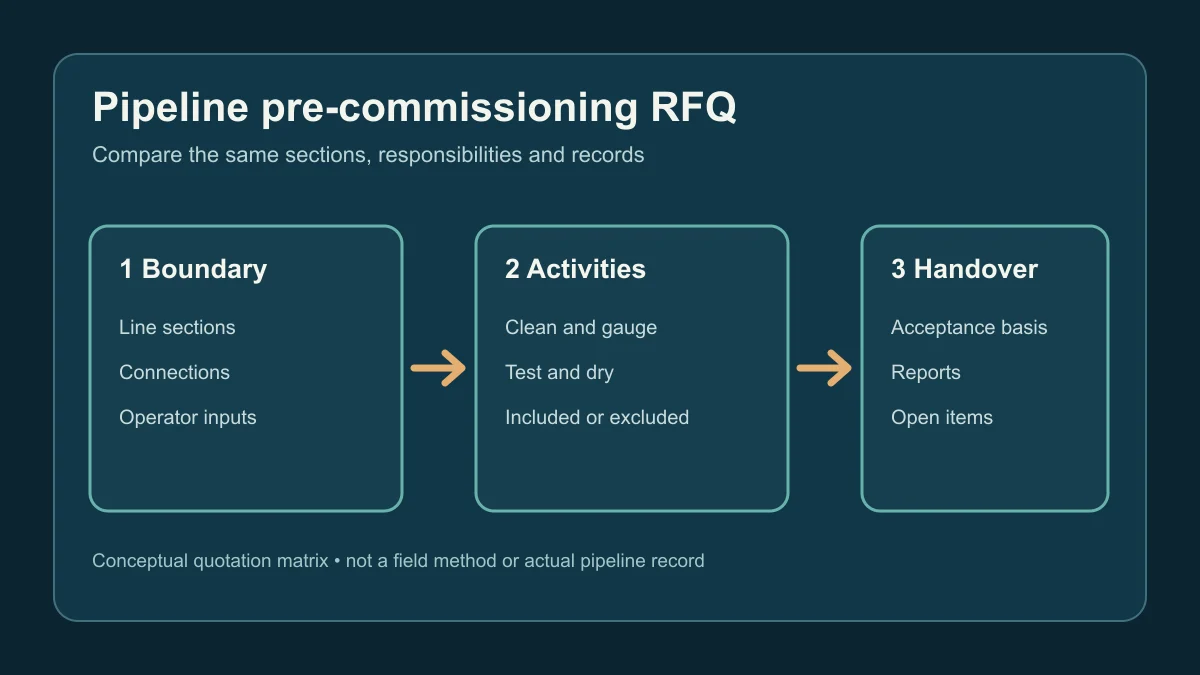
A pipeline pre-commissioning quotation should say exactly which line sections and activities the provider will deliver, what the operator supplies, how each activity will be accepted and which records will be handed over. A single price for cleaning, gauging, testing and drying is not comparable with another offer until the boundaries, sequence dependencies and exclusions are visible. The buyer should request a scope matrix before treating a service list as a complete plan.
This is a purchasing and document-control guide, not a field procedure. Pipeline design, test conditions, pig selection, temporary connections, pressure boundaries, safety controls and release for operation belong to the operator and competent specialists under the applicable project rules. A new onshore line, a submarine line and an existing pipeline returning to service do not share a universal method or acceptance value. State which case is under review and leave unknown conditions as clarifications.
Start with the actual system boundary
Identify the pipeline or section, service, location, length, nominal size, material, route drawings and applicable design or construction documents. Mark the current construction status and the interfaces to stations, risers, tie-ins, temporary facilities and existing assets. Ask which valves, branches or components lie inside each proposed activity boundary. A quotation can omit an awkward interface even while saying it covers the full pipeline. Record the responsible party for access and isolation at every end point.
The DNV-RP-F115, edition 2025-09, addresses planning, design and execution of pre-commissioning for submarine pipeline systems under DNV-ST-F101. It is useful evidence that these activities require a coordinated project basis, but its offshore scope must not be presented as a universal onshore specification. Request the project-approved standards and editions for the actual line. If those documents are not available to bidders, say what is missing and who will supply them.
Separate activities before combining the price
Ask bidders to list whether cleaning, gauging, filling, pressure testing, dewatering, drying, preservation and final handover are included, optional or excluded. The order and method need an approved engineering plan; the RFQ should not prescribe a generic field sequence. For each included activity, request the proposed deliverable, acceptance reference, required inputs, planned records and the party responsible for approval. This lets a buyer see whether two offers contain the same work rather than relying on similar service names.
For cleaning and gauging, specify the required outcome and the available line geometry, obstruction and access information. Request the provider to identify what needs verification before a tool or method is proposed. A piggable-looking nominal diameter does not establish that every valve, bend, branch or temporary fitting will permit the intended equipment. The pipeline cleaning, gauging and drying enquiry page identifies the service scope for manual Oillinko review; it does not certify a method or a provider for a particular line.
Define the test evidence without inventing test settings
If a pressure test is included, provide the approved test basis or require the bidder to list the engineering information needed to prepare it. Define who owns the test package, boundary drawings, instrument records, witness notifications, environmental permissions, water or other medium handling and final reports. Do not copy pressure, duration or medium from a previous project quotation. The US Pipeline and Hazardous Materials Safety Administration construction guidance lists problems observed around hydrostatic testing and commissioning documentation; it is US context, not a substitute for the applicable rules elsewhere.
A pressure-test completion record is different from a cleaned line, a dry line or permission to introduce the operating fluid. The hydrostatic-test report guide explains how a buyer can link a recorded result to the boundary, item identity and acceptance reference. UK HSE guidance on pressure testing likewise emphasizes a safe system of work; local law and the approved operator procedure still govern execution. A buyer should compare the proposed evidence package, not attempt to approve a test from a headline pass statement.
State the after-test condition and handover
Dewatering and drying may be important after a water-based activity, but the required final condition depends on the service and approved engineering basis. Request the target condition, measurement method, sampling locations, verification responsibility and record format from the project specification. Ask the bidder to state what happens if the target is not reached and whether additional passes, equipment time or rechecks are included. Avoid accepting a generic dry line claim without a defined measurement and boundary.
Preservation and temporary closure also need clear ownership. Identify who supplies temporary equipment, who removes it, what configuration is left at handover and what records prove that reinstatement is complete. If the line will remain idle before commissioning, ask the operator to define the permitted hold condition and its monitoring responsibility. A pre-commissioning contractor offer cannot silently authorize long-term storage conditions. Keep the construction closeout, pre-commissioning record and final operational release as separate milestones.
Compare bidders on a common responsibility matrix
Build a row for each section and activity with five fields: requested output, client-provided inputs, provider work, evidence for acceptance and open exception. Then compare mobilization, specialist personnel, equipment, consumables, utilities, site access, lifting, waste or discharge responsibilities, standby and demobilization on the same basis. A lower headline price may exclude a necessary interface or report. Ask each bidder to price alternatives and optional work separately instead of hiding a changed scope in a footnote.
For example, two offers may both say cleaning and drying. One includes the temporary connection package, gauge records and a report against an agreed final condition; the other assumes those are supplied by the client and offers only equipment rental. Neither offer is automatically preferable. The buyer must identify the missing responsibility and the technical reviewer must decide whether the proposed scope fits the approved plan. This is a hypothetical bid comparison, not evidence of an Oillinko project or supplier appointment.
Issue a controlled RFQ pack with current drawings, section list, known contents and restrictions, project standards, required outcomes, owner-supplied facilities, interface matrix, desired schedule and report index. Ask bidders to identify assumptions and deviations by document revision. The RFQ revision-control guide explains how to preserve those clarifications. Use Oillinko's pipeline and process services enquiry route to submit the scoped requirement for manual review and routing. Provider capability, exact method, timing and commercial terms require project-specific confirmation.