
Equipment Maintenance & Repair
Tank Cleaning Service RFQs: Scope, Responsibilities and Waste Handover
A procurement guide to describing a cleaning work package and its acceptance evidence.
By OillinkoPublished Updated 6 min read
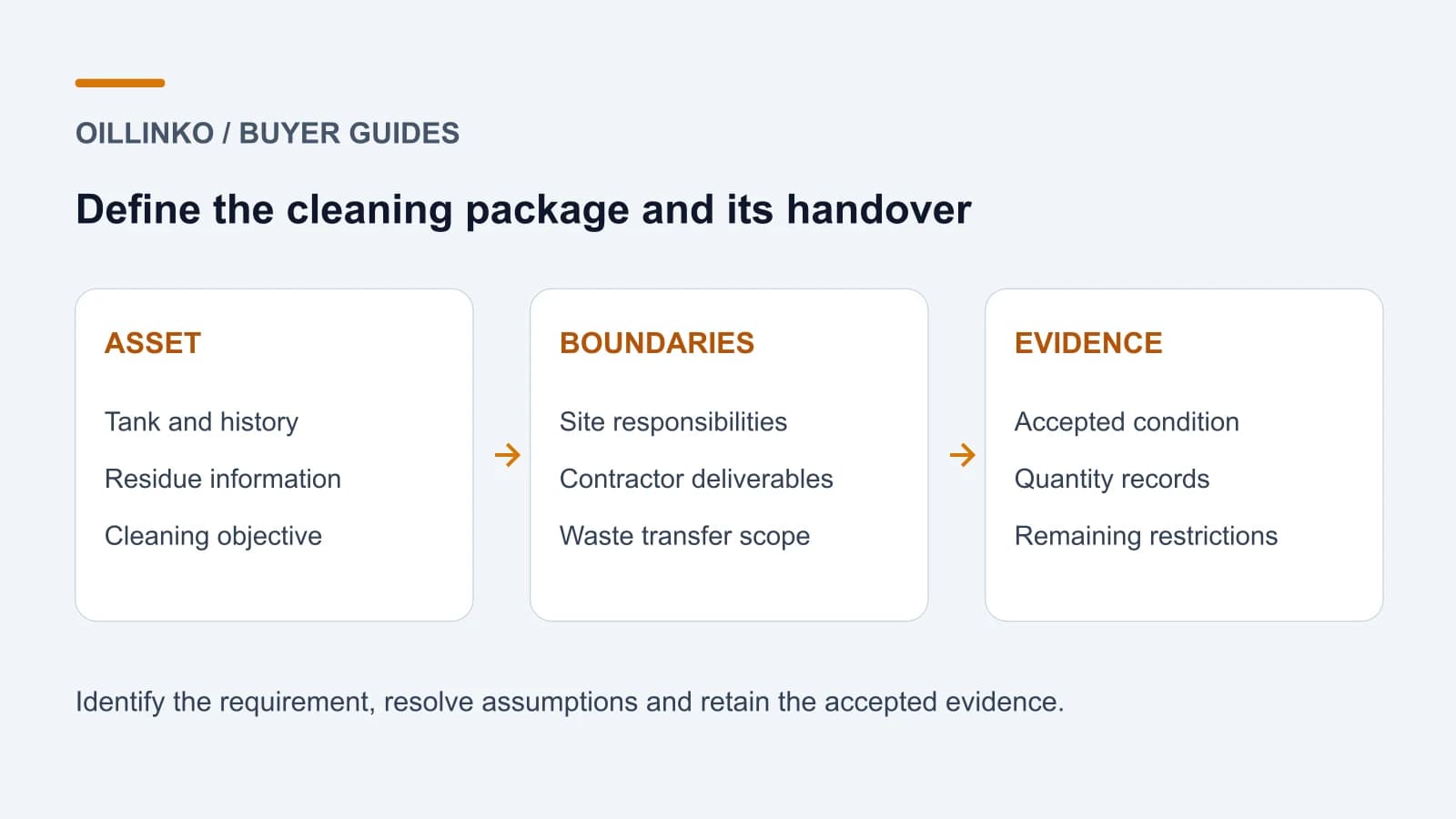
A tank cleaning service RFQ needs more than tank capacity and a requested completion date. The contractor needs the asset identity, previous contents, accessible condition information and the purpose of cleaning. The buyer needs a clear boundary between site responsibilities, contractor work and waste management. Those details make offers comparable and reduce disputes over residue quantities, waiting time and what the final handover actually means.
This guide concerns procurement scope and records. Tank entry, isolation, atmosphere assessment, rescue arrangements and cleaning methods require competent site-specific planning and authorization under applicable requirements. The OSHA overview of tank cleaning work activities shows that cleaning sits within a broader sequence of work and safety responsibilities. Its references are a useful starting point for reviewing a work package, not a substitute for the local rules or an approved site procedure.
Identify the tank and the reason for cleaning
Provide the tank tag, location, dimensions, construction and available drawings, together with the type and history of stored contents. Include available safety data and known changes of service. State whether the objective is routine removal of accumulated residue, preparation for inspection, a product change or another defined requirement. These objectives can lead to different acceptance evidence. A buyer asking for access to inspect the bottom should not assume that the same scope also establishes cleanliness for a new product.
Use current condition records and label their dates. Photographs, survey reports and residue estimates should distinguish observed information from assumptions. If access or drawings are incomplete, allow a clarification or a separately scoped site assessment before a firm offer. Link the request to the actual asset rather than sending a generic tank description. The tank and vessel equipment overview provides broader asset context, but a cleaning enquiry still requires the individual tank history and work boundaries.
Make uncertain residue quantities visible in the price basis
Describe the available estimate of sludge, retained product and other residue, including how it was obtained and what remains unknown. Do not present tank volume as the volume of waste to be removed. Ask bidders to state the quantity and condition assumptions used in pricing, together with the proposed measurement basis for reconciliation. Where the condition is uncertain, identify whether the response is a budget estimate or a firm offer against an agreed range.
For example, two contractors may quote the same tank while one includes a stated residue allowance and the other excludes disposal entirely. Compare those boundaries before comparing totals. Request the treatment of additional quantities and any approval required before extra work is authorized. Keep quantity adjustment rules, minimum charges and excluded waste categories visible. This does not remove uncertainty, but it helps the owner decide whether more condition information is worth obtaining before the contract is placed.
Allocate site and contractor responsibilities before mobilization
Prepare a responsibility schedule covering asset release, site access, work permits, utility availability, temporary facilities, concurrent work coordination and the review of specialist plans. Each item needs an accountable party and a deliverable or readiness condition. Avoid the vague phrase all permits by others when several organizations participate. The schedule should show which organization supplies information, which reviews it and which has authority to release the work, without implying that a purchase order itself permits entry.
The OSHA permit-required confined space standard includes host-employer and contractor coordination provisions where it applies. A procurement lesson is to make coordination responsibilities explicit and let the competent site team establish the applicable program. Request confirmation of the proposed work boundary and personnel responsibilities for review. Do not use this article as a checklist for declaring a space safe, choosing exposure limits or authorizing a particular cleaning or entry method.
Separate waste removal from waste acceptance and disposal
State whether the quoted work ends at collection inside the site, transfer into designated containers, transport to a nominated receiver or another agreed boundary. Identify who arranges characterization, receiver acceptance and required transfer records under the applicable jurisdiction. Request the bidder to list exclusions and dependencies. A cleaning quotation that includes residue removal does not automatically include transport, treatment or disposal, and it should not be described as doing so without explicit confirmation.
Ask for the records that will reconcile collected quantities with the agreed commercial basis and the receiving-party handover. Specify how tank identification, dates and transfer references will be linked. If the receiver or waste classification is not yet established, retain that as an unresolved dependency. The buyer can then compare a complete quoted scope with a partial scope fairly, while avoiding an unsupported assumption that every residue stream can follow the same acceptance route or price structure.
Agree what the cleaning handover will demonstrate
Describe the expected final condition in terms that can be reviewed by the owner and contractor before work. Identify the areas included, the evidence required and the person responsible for accepting the result. Distinguish cleaning completion from inspection findings, repair completion and authorization to return the asset to service. These may be separate activities with separate reviewers. A general clean certificate is difficult to evaluate unless its inspection basis, limitations and connection to the original objective are clear.
The inspection and test plan guide explains how review points can be made explicit. For a cleaning package, agree when condition information and completion evidence must be available, without inventing a generic hold point for every task. Request a report that identifies the tank, work dates, agreed scope, exceptions, condition observations and relevant handover records. Repair recommendations should remain recommendations until separately reviewed and authorized; they should not disappear into an undocumented extension of cleaning work.
Compare schedule assumptions alongside the scope
Ask contractors to separate mobilization readiness, planned work duration, waste-transfer dependencies and completion-document delivery. Identify the site shutdown window and the information needed before a realistic program can be agreed. Where waiting time may arise from unavailable utilities, asset release or receiver capacity, ask how it is treated commercially. The comparison should show the same readiness assumptions for each offer. Otherwise, a short duration may reflect a narrower scope rather than a more effective work plan.
Send the tank data, previous-content information, cleaning objective and responsibility schedule through the tank cleaning and sludge removal service page for Oillinko to coordinate manual scope review. The strongest enquiry makes known information usable and uncertain information visible. Before award, reconcile the price basis, work boundary, waste handover and acceptance evidence in one agreed scope. That creates a clearer contract package while leaving site-specific methods and safety authorization with the qualified parties responsible for the work.