
Gaskets & Sealing Products
Select sealing for the actual joint.
Read moreRead less about this category
Identify the joint and the sealing product
Industrial gaskets and sealing products help maintain containment at equipment and piping interfaces, but their suitability depends on the actual joint and service. This category covers the gasket and sealing subjects represented in the Oillinko catalogue, including replacement requirements for identified installed equipment. A flat gasket, a ring joint and a proprietary equipment seal should not be treated as equivalent because they share an outside dimension. Start with the joint drawing or equipment identification and establish the construction that the design requires before requesting a price.
The gaskets and sealing products article introduces common product descriptions and the information useful for sourcing. For standard piping joints, the flange standard, facing and size help identify the required geometry. For proprietary equipment, the manufacturer, model, part number and drawing revision may be essential. Photographs can support the enquiry, especially where markings are readable, but they cannot reliably establish hidden reinforcement, filler material or compound formulation. Mark uncertain details clearly and ask the supplier what additional evidence is needed to identify the product.
Define exposure and material requirements
Describe the process fluid and the pressure and temperature conditions relevant to the seal. Cleaning fluids, intermittent exposure, thermal cycling and external conditions may also affect selection. Material names should be specific enough to distinguish the required construction; a general request for a chemical resistant gasket leaves too much interpretation. Where the project has an approved material or manufacturer specification, include it. If alternatives are allowed, ask for the proposed material identification and supporting compatibility information, with the conditions and limitations of that information stated explicitly.
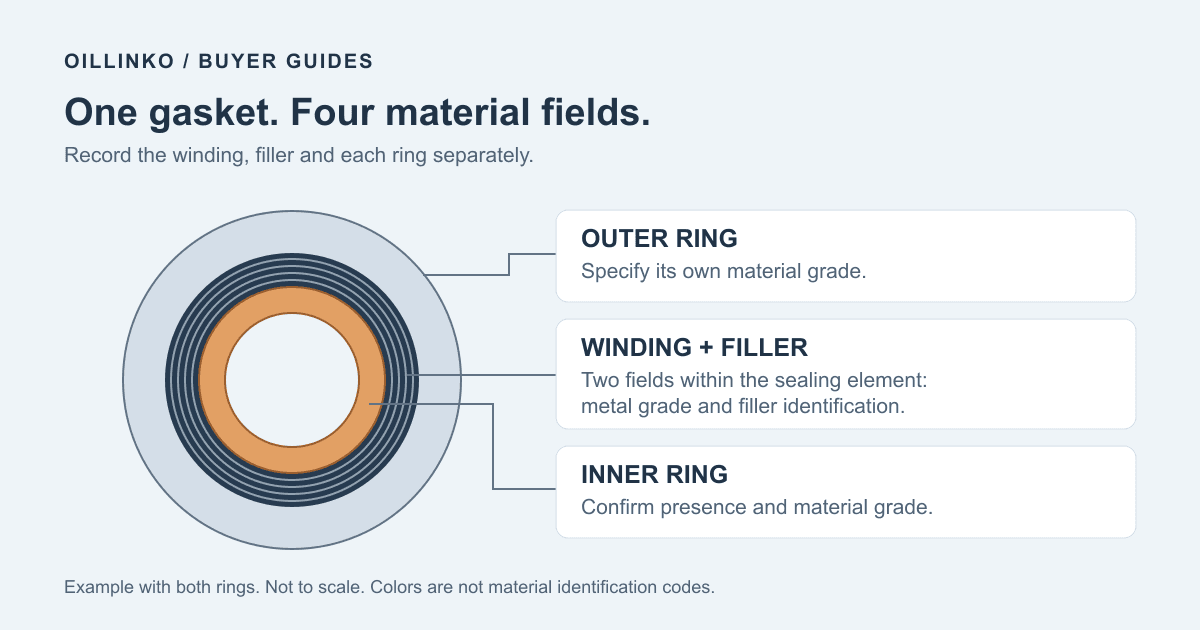
Different elements of a sealing product can have different functions and materials. A spiral wound gasket can include winding, filler and rings, while an equipment seal may combine elastomers, metal components and other materials. Identify which parts of the construction are controlled by the specification. The spiral wound gasket identification guide explains how to separate those material fields and resolve incomplete markings before ordering. A supplier should not silently replace one element while retaining a familiar product description. The materials and documentation guide explains how to request records that connect the supplied product or batch to its material description and agreed inspection requirements.
Check geometry and the surrounding joint
Dimensions include more than inside and outside diameter. Thickness, groove geometry, profile and the required fit to the mating surfaces can all matter. Existing equipment drawings should take precedence over an approximate measurement from a worn or compressed part. Explain whether the product is a direct replacement or part of a redesigned joint. If the installed part failed, provide available observations and service history for review, but do not assume that simply increasing thickness or changing material will correct the underlying condition without a proper joint assessment.
The surrounding flange and bolting arrangement contributes to sealing performance. The article on flanges, gaskets and bolting explains why these components need to be considered together. Surface condition, alignment and the approved assembly method may be as important as the replacement gasket. This buying guide does not prescribe tightening loads or installation sequences for an unidentified joint. Such values and procedures must come from the approved engineering basis and applicable manufacturer instructions, with the responsible personnel confirming their relevance to the actual assembly.
Separate static gaskets from rotating seals
A static flange gasket and a rotating mechanical seal address different sealing arrangements. Mechanical seal selection involves the rotating equipment configuration, process duty and any support system. Readers dealing with a pump seal should use the pumps and rotating equipment category and the article on mechanical seal piping plans. This distinction prevents a broad search for sealing products from overlooking the auxiliary systems and manufacturer-specific details that can be required for a complete rotating seal enquiry.
For packed equipment or proprietary seal kits, identify whether the requirement is for individual elements or a complete kit. Ask the supplier to confirm the kit contents, applicable equipment variants and any parts that are excluded. A kit name may cover multiple revisions, so the installed serial number can be important. If several items are purchased as maintenance spares, keep their package labels and intended asset references distinct. That makes the eventual receiving and storage process less dependent on recognizing similar-looking parts after their original packaging has been opened.
Plan storage, traceability and acceptance
Storage and handling requirements depend on the actual product and material. Ask the manufacturer for the relevant preservation instructions, packaging requirements and any shelf-life information applicable to the supplied item. Do not apply a universal expiry period to every gasket or elastomer. If the client requires manufacture dates, batch identification or a remaining shelf-life condition at delivery, include that requirement in the enquiry. It can affect stock availability and the acceptable supply route, especially when the order is intended for long-term maintenance inventory rather than immediate installation.
Acceptance should compare the delivered product against the final purchase description and agreed evidence. Confirm dimensions, labeling, material identification and package condition using the project's receiving requirements. A general catalogue sheet may describe a family of products rather than the exact supplied construction. Ask for any required batch-specific records before the order is placed. The inspection and material quality category explains how to distinguish supplier statements from the specific inspection and traceability evidence needed for a particular order.
Prepare the final requirement with quantities and units that match the intended supply, such as individual gaskets, complete sets or equipment-specific kits. Include the joint or asset identification, materials, drawings, documentation and requested delivery date. Use the gasket and sealing catalogue to submit the enquiry to Oillinko. Where installation or investigation is also required, describe that as a separate maintenance and repair scope, so a component quotation is not mistaken for an assessment of the complete joint or equipment condition.
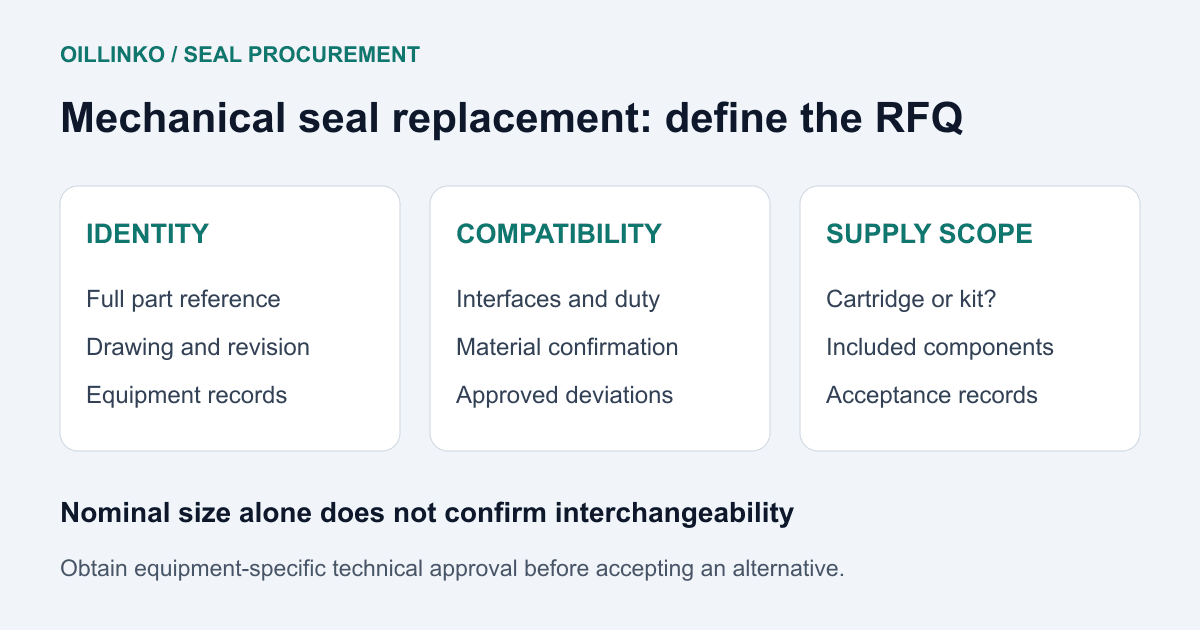
Identify a replacement pump seal
The mechanical seal replacement RFQ guide explains how to preserve assembly references, distinguish complete cartridges from repair kits, and document interfaces and duty. Use it when a spare is identified only by a photograph or nominal size, and keep proposed alternatives subject to a defined technical review.
Articles in Gaskets & Sealing Products
· 8 min read
Mechanical Seal Replacement: Identification and RFQ Guide
Identify the installed seal, define the assembly boundary and compare replacement offers.
Read article →
· 8 min read
Spiral Wound Gasket Identification: A Buyer’s RFQ Guide
Turn gasket markings, ring details and flange records into a clear replacement requirement.
Read article →

· 6 min read
Gaskets & Sealing Products Explained: Spiral Wound, RTJ & Kammprofile
Choosing the right gasket type for the flange class and service
Read article →