
Pumps & Rotating Equipment
Motor IP Ratings vs Ex Certification: What an RFQ Must Separate
An IP marking does not replace the required Ex evidence.
By OillinkoPublished Updated 8 min read
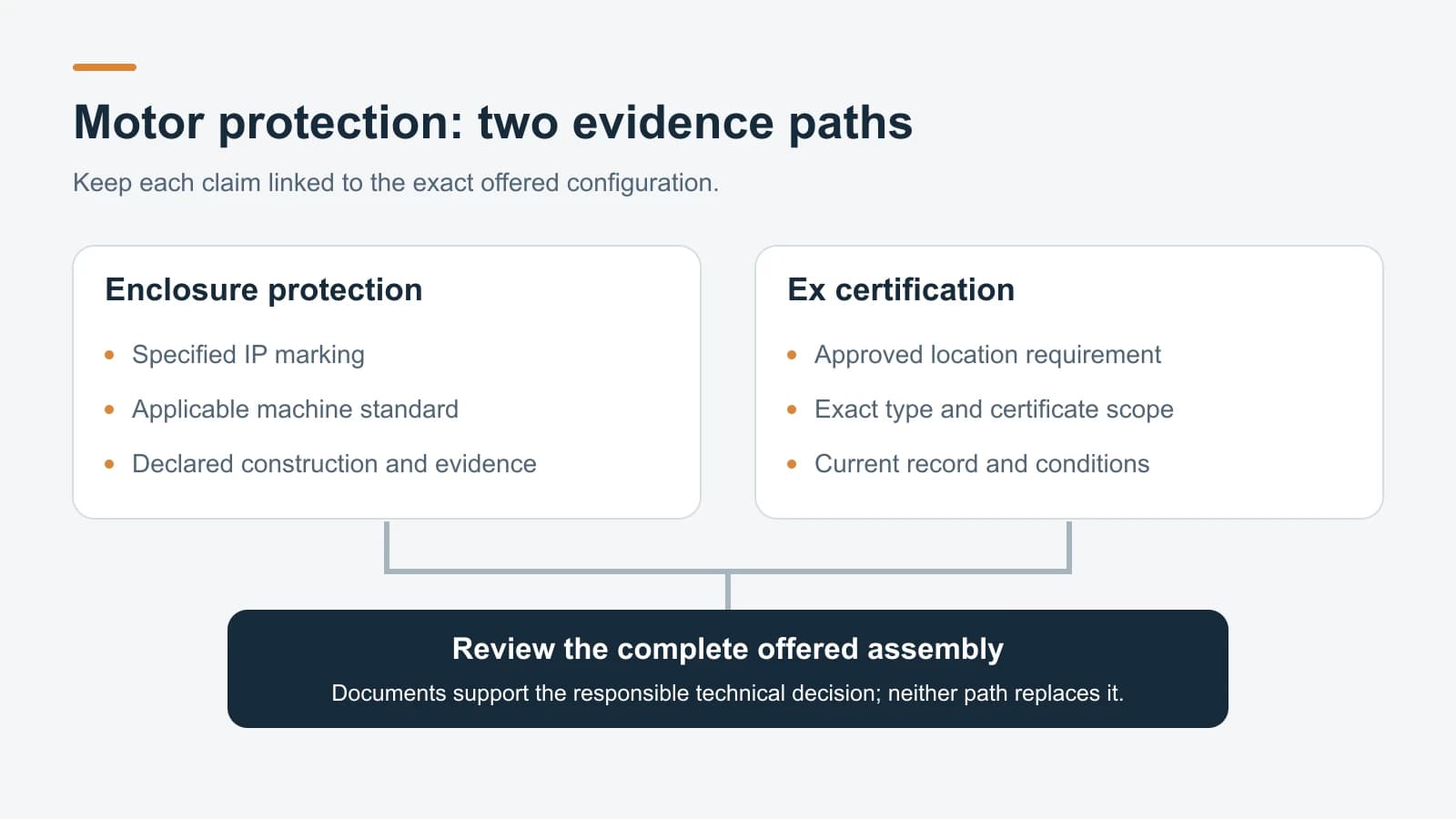
An IP rating does not establish that a motor is suitable for a hazardous area. An enclosure claim and an explosion-protection claim answer different questions, and both must be matched to the exact offered motor and the project requirements. A quotation described only as weatherproof or explosion proof leaves that review incomplete. Ask for separate identification of the enclosure rating, the required protection basis and the supporting equipment records before comparing offers or accepting a proposed replacement.
This guide is a purchasing document checklist, not an equipment-selection or installation procedure. The responsible electrical and hazardous-area specialists must establish the actual location requirements and assess the proposed assembly. A buyer should preserve that approved basis in the RFQ rather than infer it from a photograph, an old nameplate or the enclosure rating of another machine. Missing information remains an open technical question; it should not be resolved by choosing the largest-looking IP number.
Separate the two claims in the quotation
The public scope of IEC 60034-5:2020 addresses enclosure-protection classification for rotating electrical machines. It explicitly distinguishes this from the types of protection for potentially explosive environments, which belong to the IEC 60079 series. The procurement consequence is simple: an IP entry cannot stand in for the required Ex evidence. Record each claim in a separate field and ask the bidder to identify the document and configuration supporting it.
IEC 60529, consolidated edition 2.2, is the broader enclosure IP-code reference. For a motor enquiry, name the applicable machine and project standards instead of treating every enclosure document as interchangeable. Standards landing pages establish scope and edition; they do not supply the complete test requirements. The project reviewer should identify the contractual editions and the evidence expected for the offered machine, including any declared exceptions to the specification.
Begin with the approved location requirement
Include the relevant site specification, equipment tag and approved area-classification information, with revision references. Ask the responsible project function to resolve missing or conflicting requirements before a supplier is asked to confirm compliance. A previous motor may provide useful identification evidence, but it does not by itself prove the current location basis. Keep observations from the existing equipment distinct from approved requirements and from the new supplier's proposed configuration.
Prepare a comparison sheet with three columns: requested basis, offered basis and evidence or unresolved difference. Put the enclosure designation in one row and the applicable Ex marking and certification requirement in separate rows. Retain the exact wording from approved documents instead of shortening it to hazardous duty. The replacement-motor nameplate and interface guide covers power, mounting and control information; those inputs remain necessary alongside this focused protection-evidence review.
Link certificate evidence to the exact product
Where IECEx certification is required, request the complete certificate number and the proposed manufacturer and model or type designation. The IECEx official FAQ explains that IECEx equipment marking carries its certificate number and identifies the online certificate system as the controlled master record. A supplier PDF should therefore lead to an official record check, rather than being treated as the final authority simply because it displays a recognizable logo.
Record the certificate issue and observed status, then have the competent reviewer compare its scope, schedules and applicable conditions with the actual offered configuration. IECEx notes that suspended or cancelled certificates remain visible in its database. Finding a certificate is consequently different from finding a current record that covers the proposed product. If the number, product description or manufacturer differs, preserve the mismatch and request an explanation. Do not describe an unresolved search result as confirmed compliance.
Keep accessories and operating configuration visible
Ask what is included with the motor: terminal arrangements, cable-entry items, sensors, heater, brake or other accessories where required. Request the relevant instructions and identify which supplied items have separate documentation or approval boundaries. A certificate for one component should not silently become a claim for every part of the delivered package. The purpose is to expose the assembly and its evidence for technical review, not to prescribe a cable-entry or protection arrangement in a purchasing article.
State whether the proposed motor will be supplied for the existing starter or a variable-speed-drive arrangement, and request the manufacturer's applicable limitations and supporting documents. Keep any control, accessory or construction change visible in the quotation. IECEx explains that design changes are referred to the issuing certification body to determine whether a certificate update is required. The buyer should obtain the relevant confirmation rather than assuming that a familiar model family covers every offered option or modification.
Do not turn a higher IP number into universal approval
Describe the actual environmental exposure and ask the bidder how the proposed construction meets the approved requirements. The IEC 60034-5 scope identifies limitations including condensation and corrosive dust or vapour; its IP classification is not a complete assessment of every environmental threat. Keep corrosion protection, drainage or other project-specific requirements identifiable for the responsible reviewer. An enclosure number alone should not erase a separate requirement simply because the quotation calls the motor suitable for outdoor service.
Consider an illustrative bid comparison in which two motors have the same output and IP marking. One bidder identifies a specific current certificate and supplies the offered configuration; the other attaches a certificate for a related type but leaves the relationship unexplained. The two documentation packages are not yet equivalent for review. That does not prove that either machine is acceptable or unacceptable. It identifies the clarification required before the buyer can compare them on the same approved basis.
Close the purchase and receiving record consistently
Agree which drawings, nameplate details, instructions and certification records must accompany the goods, and when they are reviewed. At receipt, link the actual item identity to the approved offer and resolve discrepancies through the buyer's normal acceptance process. Preserve the distinction between supplier declaration, document review, physical receipt and installation release. For an existing unit sent for repair, use the separate motor rewinding and acceptance-record guide; buying a replacement does not authorize changes to a certified machine.
Submit the equipment reference, available nameplate photographs, approved location and environmental requirements, and requested documentation through Oillinko's electric-motor enquiry page. Oillinko reviews and routes requirements manually; catalogue coverage is not certification, stock confirmation or an engineering approval. The quality and documentation page explains the wider enquiry context. Keeping enclosure and Ex evidence separate gives bidders a clearer question and gives the responsible reviewer a record of what has actually been confirmed.