
Inspection & Testing
Hydrostatic Test Reports: Boundary, Acceptance and Traceability
Specify the evidence behind a pressure-tested claim.
By OillinkoPublished Updated 8 min read
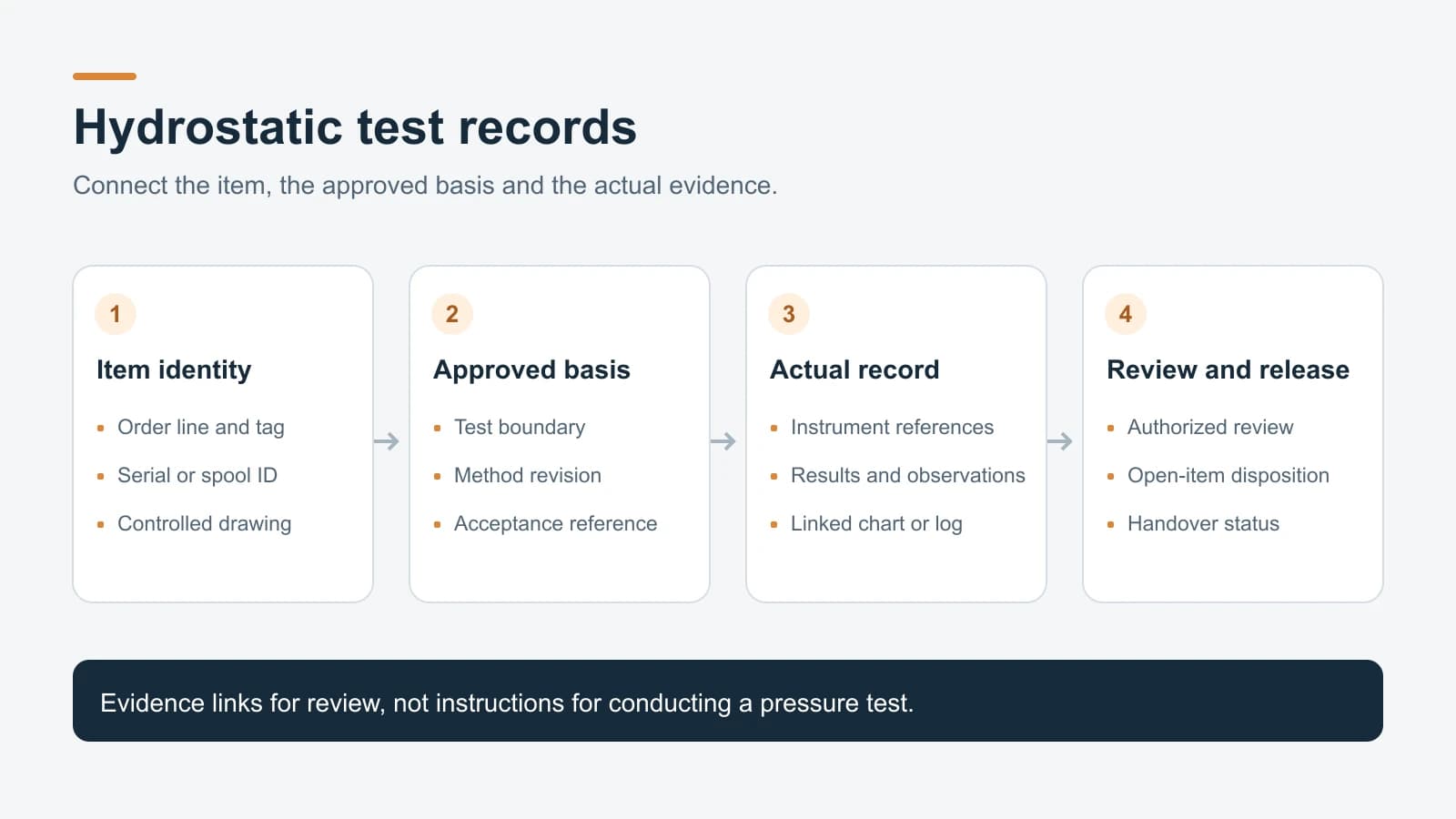
A hydrostatic test report is useful to a buyer only when it connects the recorded result to the exact item, the approved test boundary and the acceptance basis. A certificate headed “pressure tested” may leave unanswered which assembly was tested, which drawing revision applied, what was observed and who accepted the outcome. Request those links in the RFQ before comparing a supplier's documentation package. A pressure chart by itself cannot establish that every component in an order has met every contractual requirement.
This is a guide to specifying and reviewing records, not a procedure for conducting a pressure test. The responsible technical authority must determine the applicable method, medium, pressure, duration, precautions and acceptance criteria for the actual equipment. Those values must not be copied from an unrelated report. The UK HSE's GS4 guidance addresses safe systems of work for pressure testing. Its scope reinforces why a purchasing checklist cannot replace a competent assessment of the proposed test.
Identify the item and the tested boundary
Begin with the purchase-order line, equipment tag, serial number or spool identifier, and the controlled drawing that defines the supplied assembly. Ask for a boundary drawing or other agreed identification showing what was included and excluded. A report for one loose component is different from evidence for an assembled skid or completed piping package. Where multiple items are covered by one report, require an explicit item list rather than assuming that a similar description covers the entire order.
Keep the tested configuration distinguishable from the delivered configuration. Ask the supplier to identify temporary closures, excluded instruments or other configuration differences relevant to the agreed scope, and how reinstatement is documented. The buyer is requesting evidence of what was actually assessed, not specifying how the contractor should assemble a test arrangement. The spool dimensional-inspection guide complements this record by linking physical fit to a drawing; dimensional conformity and pressure-test acceptance answer different questions.
Name the governing requirements and approval roles
State the equipment or piping code, its contractually applicable edition, the project specification and the approved test-document revision. ASME identifies examination, inspection and testing within B31.3's process-piping scope. That public scope statement does not set a universal pressure or acceptance rule for every item sold into oil and gas. A pressure vessel, a valve and a piping assembly may have different applicable requirements. Resolve the governing basis with the responsible reviewer before requesting a final compliant offer.
Identify who approves the proposed test documentation, who performs the activity, who witnesses agreed points and who accepts the final report. Record the purchaser's notification requirements and whether an agreed hold point prevents the next stage without release. Our inspection and test plan guide explains the distinction between attendance and authorization. A witness signature should be interpreted according to its declared role, rather than automatically treated as approval of design, test results and shipment.
Separate planned parameters from actual results
Request a report format that distinguishes the approved test requirements from the actual recorded conditions and observations. Depending on the agreed method, relevant fields may include the medium, pressure units, applicable temperature records, start and finish identification, instrument references and the results of required examinations. The required content belongs in the project-approved document package. Do not fill missing results with the planned value or accept a blank field as evidence that the requirement was met.
Where a chart or electronic log is required, define how it is linked to the report and the item list. Ask for a legible time basis, axis identification and the contextual information needed to understand the record. Any interruption, repeat test, amended value or omitted interval should have an explanation and a controlled disposition. A reviewer must assess variations against the approved method and actual conditions; a procurement team should not diagnose a pressure change from the shape of a chart alone.
Connect instruments to the measurement evidence
Ask the provider to identify the instruments used by a unique reference that can be matched to their calibration records. Specify the documentation needed for the project reviewer to assess range, units, calibration status and suitability for the recorded measurement. A photograph of a gauge with a sticker may help identify the instrument, but it does not supply the calibration result or establish that the instrument was suitable throughout the relevant range. Keep the report and its supporting records together.
NIST explains metrological traceability as a property of a measurement result supported by a documented calibration chain, with contributions to uncertainty. Traceability alone does not establish fitness for a particular purpose. Accordingly, ask the responsible measurement reviewer to assess the supporting evidence rather than relying on a broad “traceable” stamp. The pressure-gauge calibration certificate guide covers the complementary questions about instrument identity, results and the stated calibration scope.
Make acceptance and unresolved findings explicit
The report should identify the acceptance reference and the conclusion reached by the party authorized under the project arrangements. Ask how observations, deviations, repairs and repeat examinations are linked to the final outcome. If a concession or engineering disposition is needed, retain its reference, revision and approval status. A supplier's generic pass statement should not silently replace an unresolved project requirement. Equally, a purchasing reviewer should not invent a rejection threshold absent from the agreed specification.
Distinguish test completion, report acceptance, reinstatement and shipment release in the document register. They may be related milestones, but one does not automatically prove all the others. A successfully completed test can still have an open documentation action or an outstanding delivery condition. Ask for an open-item list that states the owner of each action and what evidence will close it. This keeps a conditional status visible when quotations, delivery dates and inspection arrangements are compared.
Price the complete evidence and handover scope
Include the required report, boundary identification, supporting calibration records, witness arrangements and final document format in the RFQ. Ask bidders to distinguish included work from separately charged inspection attendance, report revisions, repeat activities or additional certificates. Define when documents are submitted for review and when the final records are due. A low quotation that excludes the agreed evidence is not directly comparable with an offer covering a complete reviewed package.
For handover, request a controlled index connecting the order line and item identity to the approved basis, actual report, supporting evidence and final disposition. Preserve the original issued record alongside any clearly identified revision. Check that the records accompany the actual supplied items, rather than a representative sample whose applicability is unspecified. Use Oillinko's inspection and engineering enquiry route to submit an equipment list and available requirements for manual review and routing. The quality and documentation page explains the enquiry context; no article or directory listing proves a provider's appointment or item-specific conformity.