
Pumps & Rotating Equipment
Bearing Storage Before Installation: Shelf Life and Receiving Records
Ask what the storage evidence supports before accepting a spare.
By OillinkoPublished Updated 8 min read
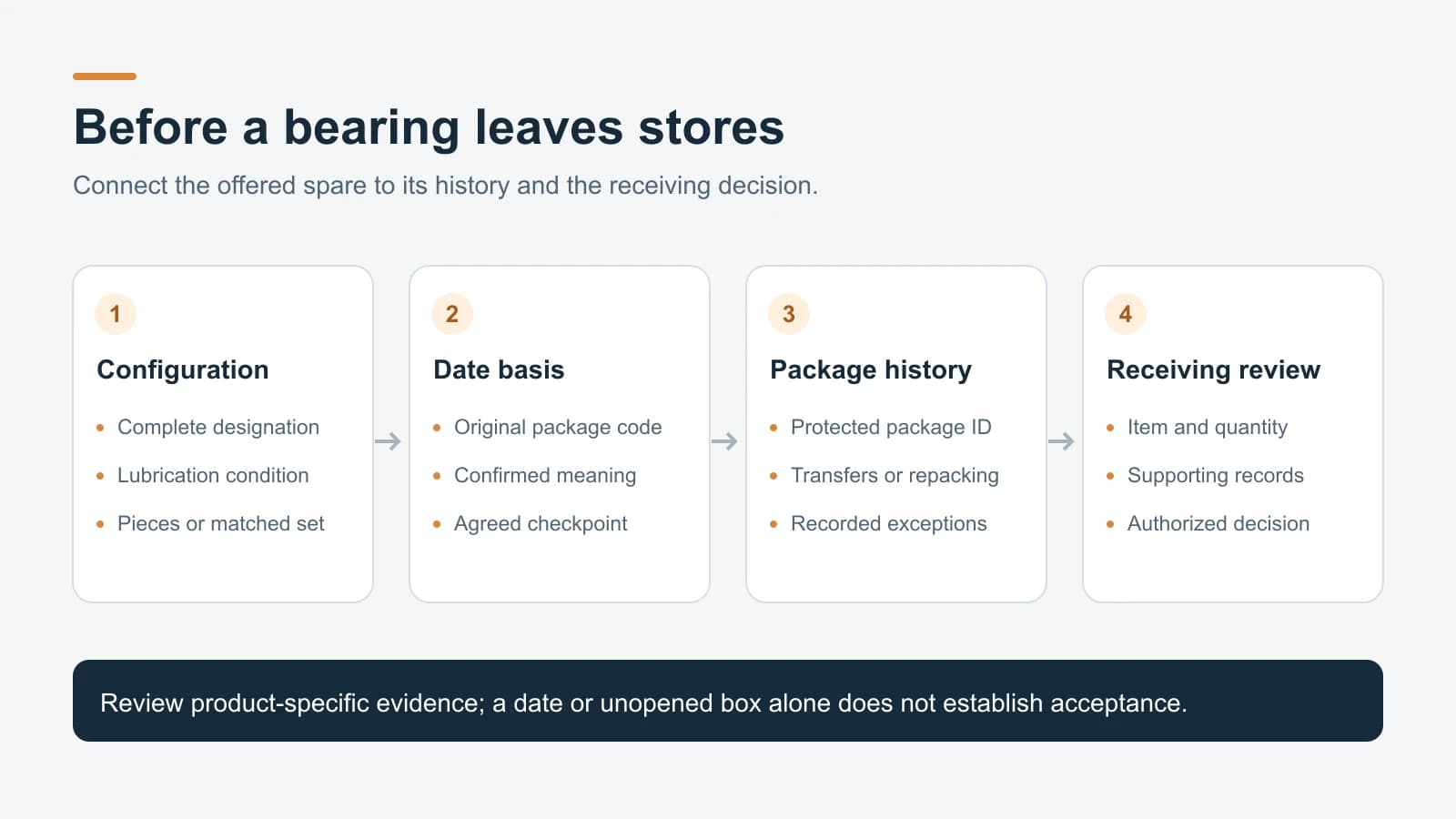
A correct bearing designation does not settle whether a stored spare is ready for acceptance. Before ordering, connect the offered bearing to its packaging, lubrication condition, documented storage history and applicable manufacturer guidance. A recent sales invoice does not make the bearing newly manufactured, and an unopened box does not by itself establish the conditions in which it was kept. Ask for the evidence needed by your receiving and technical reviewers, with missing information shown as an open question rather than an assumed pass.
This guide concerns purchasing and receiving bearings that will remain in stores before installation. It does not prescribe a warehouse climate, an inspection method, relubrication or a universal expiry date. The required controls depend on the actual bearing, lubricant, package and application. Installation suitability remains a separate engineering decision. Start with the approved equipment requirement and obtain the product-specific storage basis for the offered item before agreeing how its age and condition will be assessed.
Identify the storage-sensitive configuration
Record the complete designation, quantity and intended equipment position, then ask whether the bearing is supplied ungreased, pregreased, sealed, shielded or as part of a larger assembly. Keep the offered lubricant identification where it is relevant and available. An RFQ for a matched arrangement should retain the set identity through receiving and stock allocation. The replacement-bearing identification guide explains designation and supply-scope questions; the additional issue here is the history and protection of the particular items offered.
NSK Technical Insight TI/E/0018, Bearing Storage distinguishes individually packaged bearings from bearings in bulk packaging, and differentiates greased and ungreased supply. Its stated periods depend on defined storage conditions. The document also explains that lubricants and preservatives influence shelf life. For procurement, this means that a period copied from a bearing catalogue needs its product and packaging context. It should not become an unconditional limit for every bearing on a multi-item spare-parts list.
Ask what the dates actually represent
Request the original package codes and the supplier's explanation of relevant manufacturing, packing or lubrication dates. Keep the raw code alongside its confirmed interpretation, especially where it identifies only a month, quarter or batch. Distinguish those records from the seller's receipt date, invoice date and dispatch date. If a date basis cannot be established, record that limitation explicitly. Avoid changing an uncertain code into an exact date simply because the buyer's inventory system requires one.
Write any remaining-storage-life requirement with a clear checkpoint: for example, the agreed receipt event rather than an unspecified point during quotation. Ask the bidder to show the applicable guidance, reference date and declared remaining period on the same line. The buyer should set the contractual requirement with its responsible technical function. A supplier statement that an item is unused answers a different question from how long it has been stored and whether the declared storage basis is supported.
Review packaging and the custody history
Ask whether the original protective package has remained closed and undamaged, whether the item has been transferred between stores, and whether any repacking is documented. Retain the association between each package and its labels when shipments are split. A replacement outer carton may protect a consignment without being the original bearing package. Request an explanation of which packaging layer changed and what happened to the protected item; do not infer exposure merely from a new shipping carton.
The storage section of GMN's ball-bearing handling guidance calls for original packaging and protection from dust, moisture and temperature or humidity fluctuations. It gives a product-specific shelf-life statement under proper storage. These conditions illustrate why elapsed time alone is incomplete evidence; they are not an Oillinko storage specification for another manufacturer's product. Ask the offered manufacturer to identify the applicable instructions and any known departures from them, with technical questions referred to the responsible reviewer.
Keep the shipping package separate from bearing protection
State the expected transport route, consolidation stages, receiving location and planned wait before installation. Ask who maintains the required protection between dispatch and the agreed delivery point. Coordinate these questions with the export-packing RFQ guide, which concerns the complete shipping package and its records. A robust crate and a complete packing list can support transport planning, but neither establishes the internal bearing package's preservation history.
For example, a buyer may receive twelve individually packaged bearings inside one export case and later issue four to a maintenance team. The stock record should keep the remaining eight linked to their own labels and supporting documents, rather than retaining only the case number. If the bearings arrived from different batches, preserve those distinctions. This illustrative receiving scenario is a record-design question, not evidence of any Oillinko delivery or a recommendation to open protective packaging for routine counting.
Define the review route for damage or incomplete history
Agree how receiving staff will record external package condition, missing labels, date discrepancies and reported exposure. Keep photographs and supplier correspondence tied to the affected purchase line and quantity. Route an exception through the buyer's quality process before marking the item accepted for its intended allocation. A visual observation is useful evidence but cannot establish every internal condition. Equally, a document gap should be described precisely instead of being relabeled as proven physical damage.
Do not assume that changing the label, adding grease or arranging an informal inspection resets storage life. If the supplier proposes reinspection, reconditioning or repacking, request the manufacturer-approved basis, scope, responsible party and resulting documentation before agreeing the work. Keep the original age and history visible. An acceptance decision should state what was reviewed and which limitations remain; a new commercial certificate should not silently replace the original evidence or be presented as a guarantee of service performance.
Compare quotations on the same evidence basis
Ask bidders to separate product identity and condition from delivery time, price and documentation inclusions. Where immediate availability is proposed, request the available storage evidence before treating that offer as equivalent to future production with a different age basis. Keep any conditional acceptance or proposed deviation in the comparison sheet. The useful output is a transparent choice between stated offers, with unanswered technical questions assigned for review before the purchase commitment.
Send the full designation, equipment reference, quantity, planned receipt and use windows, and required storage records through Oillinko's seals, couplings and bearings enquiry page. Requests are reviewed and routed manually. The quality and documentation page provides the wider enquiry context. Oillinko does not infer stock condition, authenticity or installation approval from a catalogue entry. A clear receiving record helps the buyer connect the ordered requirement to the actual supplied items and make an informed acceptance decision.