Gaskets & Sealing Products
RTJ Gasket RFQs: Ring Number, Profile, Material and Hardness
A ring number is one field in a complete replacement requirement.
By OillinkoPublished Updated 8 min read
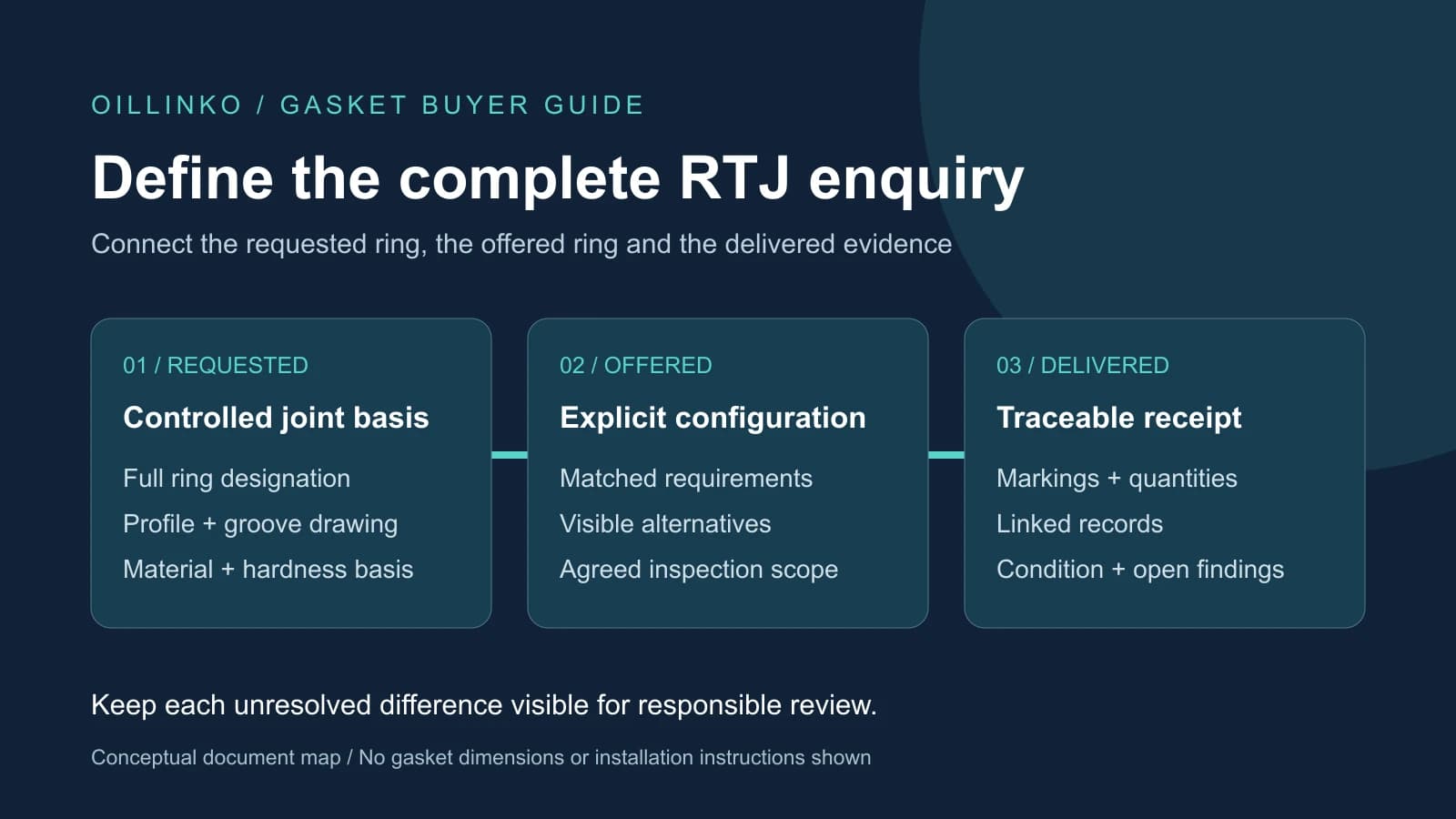
An RTJ gasket RFQ needs the complete ring designation, its required profile, the mating flange and groove reference, and the specified material and hardness evidence. A description such as stainless ring gasket for an existing valve is incomplete. Even a legible ring number should be connected to the approved joint record rather than used as a substitute for it. The buying task is to make that relationship visible so quotations can be compared without silently accepting a different ring or material condition.
This guide covers identification and procurement of machined metallic ring-joint gaskets. It does not select a gasket for an unknown service or provide flange assembly, machining or pressure-testing instructions. The responsible technical reviewer must approve the joint requirements and any proposed substitute. An old ring, a flange photograph and a previous invoice can help recover information, but none alone establishes what the current connection requires or whether its groove remains suitable.
Recover the complete designation and its source
Copy visible markings exactly, including the prefix, ring number, material identification and manufacturer reference where present. Record which item the photographs show and link them to the equipment tag or joint number. Separate confirmed markings from characters inferred from a worn surface. If an identifier is uncertain, retain that uncertainty in the enquiry and request the controlled equipment or flange documentation. A bidder should not have to guess whether a missing prefix was intentionally omitted.
RTJ is a family description, not one universal cross-section. James Walker's ring-joint product overview lists R, RX and BX alongside other machined metallic gasket forms. Identify the required family and, for an R-type enquiry, the specified oval or octagonal profile. Keep a proposed change to that description visible for review. The gasket family overview provides wider context; it is not a dimensional interchangeability table.
Tie the ring to the actual flange and groove
Include the flange standard and edition, size and pressure designation, equipment connection reference and applicable drawing revision. Where the drawing defines a specific groove, give its controlled reference rather than asking a supplier to reconstruct it from an overall flange diameter. State whether both mating sides have been identified. Any disagreement between the old ring, equipment record and flange drawing should be resolved by the responsible reviewer before a replacement is treated as fully specified.
KLINGER's ring-joint guide, issue 01 dated 28 August 2019, pages 1 and 2 distinguishes oval and octagonal R profiles and describes RX and BX arrangements separately. Its qualitative descriptions illustrate why groove and profile information matter. They are not permission to substitute one style across every connection. Ask the bidder to identify the offered ring against the actual approved flange arrangement, including any dimensions or configuration differences requiring review.
Separate the material grade from hardness evidence
Specify the required material using the approved grade or specification, not just stainless steel or soft iron. Include the relevant service conditions and any project-specific material requirements for technical assessment. Request the proposed material and any deviation explicitly in the offer. If a sour-service requirement applies, identify its approved basis and supporting documents; the presence of a familiar alloy name does not settle every application. Keep manufacturing origin, material identity and distribution location as separate purchasing fields.
Hardness is another defined requirement, not a synonym for chemical grade. KLINGER's guide identifies chemical compatibility and the relationship with flange hardness as material-selection considerations. Ask which hardness requirement, method and evidence will apply to the offered rings under the project documents. Do not turn a general brochure figure into a universal acceptance limit. Where a report uses a different scale or method from the requirement, refer the difference for technical disposition rather than assuming numerical readings are directly equivalent.
Define the standard and inspection deliverables
The public ASME B16.20-2023 scope covers materials, dimensions, tolerances and markings for specified metallic gasket families, including ring-joint gaskets. State the edition selected for the purchase and the applicable flange or equipment requirements. A quotation mentioning B16.20 should identify its offered construction and evidence; the standard name does not by itself prove that the particular delivered ring matches the order. Public scope pages do not replace the full contractual standard.
Agree which material, dimensional, hardness and marking records must accompany the goods and how they connect to the ring or batch supplied. Identify any inspection witness or document-review stage before production or dispatch. The heat-number and certificate traceability guide explains the record linkage. A material certificate detached from its product identity leaves an unresolved evidence gap, even when the reported chemistry appears suitable. Ask how split quantities and separately packed batches will retain that connection.
Compare bids with a visible difference record
Build a short review sheet with requested, offered and evidence-needed columns. Put the full ring designation, profile, flange drawing, material, hardness requirement and documentation scope on separate rows. Add quantity and unit, packaging, manufacturing origin, delivery destination and required date. Ask each bidder to declare exclusions and alternatives rather than hide them inside a general equivalence statement. This gives the reviewer a defined set of questions and prevents a low price from appearing complete merely because its description repeats the ring number.
Consider a labelled hypothetical comparison: one offer identifies the requested profile and material but excludes the agreed inspection record; another includes a certificate package but proposes a changed profile. Neither description closes the original enquiry without clarification. The buyer should request the missing evidence or an explicit technical disposition of the change. This example does not establish that either proposed product is unsuitable. It shows why product identity and documentary completeness must be assessed together before the commercial comparison is finalized.
Preserve identity through packing and receipt
Require protective packing that maintains the identity of each line and prevents contact damage to the machined sealing surfaces. Agree the label and packing-list references before dispatch. At receipt, reconcile the delivered markings, quantities and records with the accepted quotation and controlled drawings. Record damage, unidentified rings or inconsistent documents for disposition under the owner's normal process. A stores receipt is distinct from technical acceptance and does not authorize installation or rework of the mating groove.
Send the joint reference, available markings, flange drawing, required material and evidence scope through Oillinko's ring-type joint gasket enquiry page. Oillinko reviews and routes enquiries manually; catalogue coverage does not confirm stock, manufacturer authorization or engineering approval. If the existing item is a spiral wound assembly, use the separate spiral wound identification guide. A useful RTJ purchase record connects the ring that was requested, the ring that was offered and the evidence received with the goods.