
Valves & Actuation
Pneumatic Actuator Air Demand: Pressure, Volume and Stroke Time in an RFQ
An air-pressure entry does not define a complete pneumatic utility requirement.
By OillinkoPublished Updated 8 min read
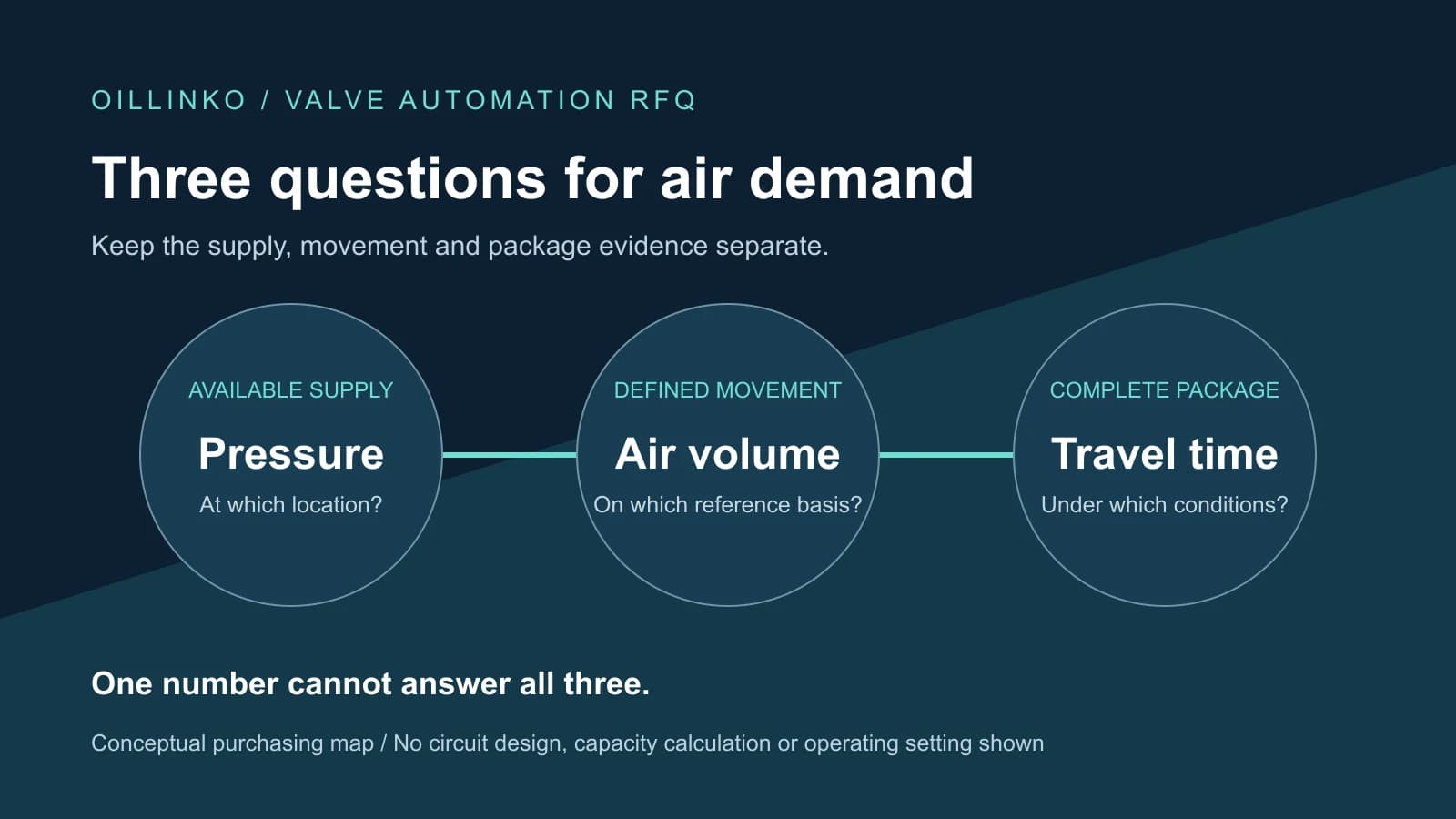
A pneumatic actuator RFQ should separate the supply available at the package, the air consumed for defined movements, and the evidence for required travel time. A single pressure entry does not answer all three questions. Nor does a small consumption figure prove that a complete valve automation package can meet a particular timing requirement. Ask bidders to identify the units, reference conditions, movement and included accessories behind each figure before comparing their utility requirements.
This guide addresses enquiry preparation and quotation review. It does not size a compressor, select a control circuit or prescribe pressure adjustments. The responsible valve, controls and utility specialists must assess the complete arrangement. Start with the approved valve duty and required operating behavior, including the defined response to loss of supply. Where those requirements are unresolved, retain them as open inputs instead of using a brochure value as the missing project decision.
State where the supply conditions apply
Give the minimum, normal and maximum available supply pressures, with units and an explicit gauge or absolute basis. Identify the location to which those conditions apply: a plant header, the package connection or another agreed point. A pressure at one location should not silently become a guarantee at another. Provide the utility specification and relevant operating cases, and ask the bidder to identify the supply basis used for the offered package assessment.
Keep the guaranteed available supply separate from the equipment's permitted pressure range and from any proposed regulator setting. These are different entries in a quotation review. Request confirmation that the offered configuration meets the approved duty across the required supply cases, and expose any qualification. The actuator replacement and interface guide covers the broader valve output, mounting and control questions that remain necessary alongside this utility evidence.
Identify what the air-volume figure means
Ask whether a quoted volume describes an internal chamber or air consumption expressed at stated reference conditions. Record the complete unit and its definition, including the reference pressure and temperature where relevant. A label such as litres does not explain the reporting basis by itself. Request the manufacturer's applicable definition rather than assuming that normal litres, actual compressed volume and every supplier's standard-volume convention are numerically interchangeable.
The EL-O-Matic F-Series data-sheet bundle, revision 18, October 2021, printed page 6 presents chamber volumes separately from consumption per stroke. Its table also distinguishes movement direction and supply pressure. That layout is a useful illustration of the questions to preserve in an RFQ, not a source of universal values for another actuator. Ask for the current data applicable to the exact model, configuration and travel offered.
Define a stroke and a cycle in the duty schedule
State whether the requested figure is for opening, closing or a complete operating cycle, and define the actual angular travel or linear stroke. Ask which movements use supplied air for the offered arrangement and which data apply to each movement. Keep double-acting and spring-return configurations identifiable. Do not automatically double a single table entry or assume that every return movement has the same air requirement as the powered movement of another configuration.
Provide the expected operating frequency and distinguish routine operation, repeated modulation and any separately defined demand event. For several valves, identify which movements may be required together and who owns the combined utility review. A quantity of actuators does not itself define simultaneous demand. If the schedule is incomplete, request a conditional offer with the missing duty assumptions listed. The buyer can then obtain an engineering decision rather than compare offers based on different operating patterns.
Keep air per movement, flow and travel time distinct
An air quantity for one movement and a flow expressed per unit time describe different parts of the requirement. Retain both with their respective reference conditions when requested by the technical reviewer. For a travel-time claim, ask the bidder to identify the complete package and the conditions supporting the statement. Do not treat an average demand calculation as proof that the actual valve will complete a required movement within the specified time.
The same manufacturer bundle lists its travel-time test conditions on printed page 5, including the control-valve flow capacity, pipe diameter, supply, load, travel and temperature. This shows why a timing value needs its test basis. Ask whether the offered tubing, solenoid, fittings and exhaust arrangement are represented by the submitted evidence. The solenoid valve RFQ guide addresses that component's own selection inputs; a suitable actuator alone does not establish the performance of every connected control item.
Include accessories and air quality in the package boundary
List the positioner, pilot or solenoid valves, regulator, filter, boosters and other supplied or retained accessories as applicable. Ask which air-demand figures cover the actuator alone and which cover the assembled package, including any declared continuous consumption. Require exclusions to be visible rather than silently combine unrelated catalogue figures. Where a receiver or backup supply is part of the requirement, request a separately defined engineered scope and review responsibility; this article supplies no storage-volume or protective-function calculation.
Define the required air quality separately from pressure and consumption. ISO 8573-1:2010 classifies compressed-air purity with respect to particles, water and oil. A reference to the standard alone does not choose the classes needed for the actual equipment. Ask the bidder to state the applicable manufacturer requirements and reconcile them with the approved utility specification, environment and supplied accessories. Confirm the required edition and evidence without inventing a universal purity class for all pneumatic actuators.
Compare and verify the same evidence boundary
Use a comparison sheet that separates supply location and range, exact configuration, volume basis, movement definition, duty schedule, included accessories and travel-time evidence. For a hypothetical pair of bids, one may report air per opening stroke for a bare actuator while another reports a complete cycle for an assembled package. The lower-looking number cannot establish lower demand until those boundaries are reconciled. Request the missing definitions before drawing a commercial or technical conclusion.
Agree what will be demonstrated before dispatch, which conditions will be recorded, and what remains for approved site verification. Link results to the actual equipment identifiers and the accepted pneumatic diagram. The inspection and test plan guide helps define review responsibilities. Send the duty, utility specification and available package records through Oillinko's actuators and positioners enquiry page for manual review and routing. Availability, suitability and acceptance remain item-specific decisions supported by the offered evidence.