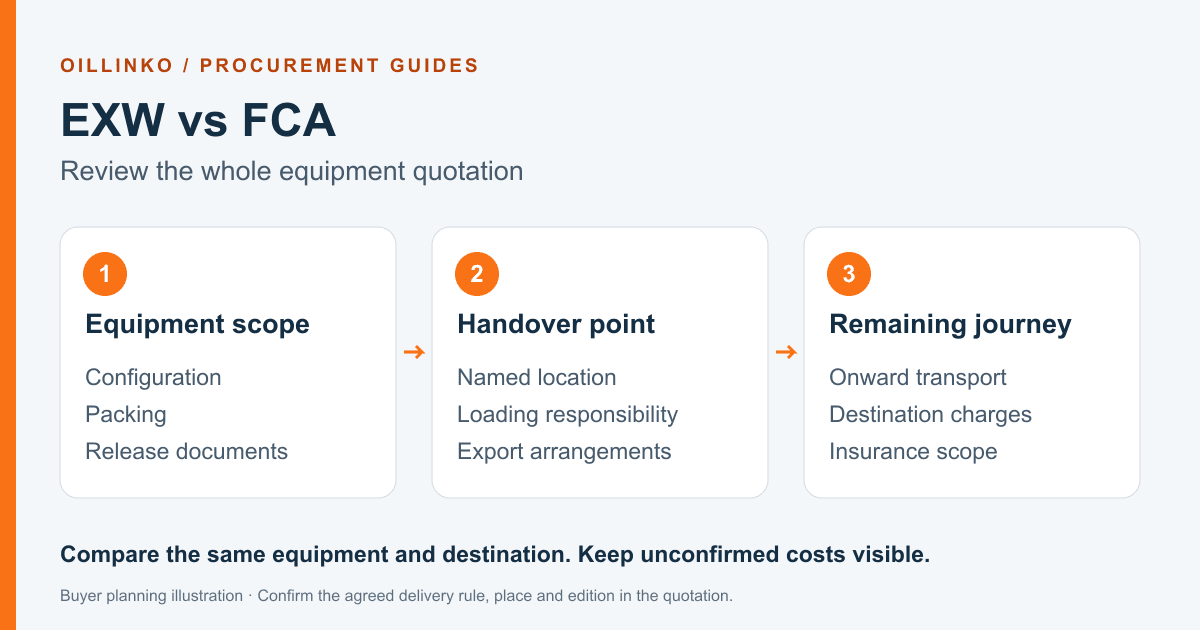
Export packing for oil and gas equipment should be specified before the goods reach the dispatch area. A quotation saying seaworthy packing included does not explain how a valve, pump assembly or instrument will be protected, which storage conditions were assumed, or whether loose accessories can be identified on arrival. These gaps can leave the buyer comparing different scopes under the same description. Request a packing proposal that connects the equipment, journey and receiving arrangements to clear deliverables.
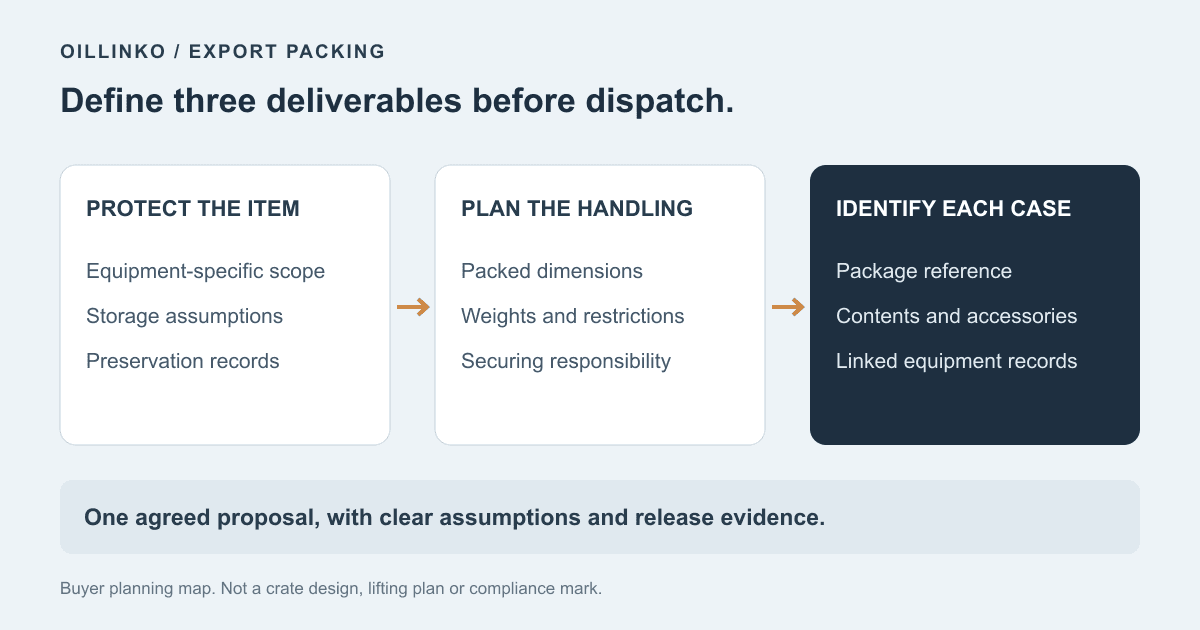
Three questions deserve separate answers: how the item is protected, how the packed cargo is handled and secured for transport, and how every package is documented. This guide addresses the information to request and review. It does not provide a crate design, preservation recipe or lifting and lashing procedure. Those depend on the supplied equipment and actual transport arrangement. Resolve them with the manufacturer and competent packing and logistics providers rather than copying a method from an unrelated shipment.
Define the journey and storage assumptions
Tell the supplier the intended transport modes, collection point, destination and any expected transshipment or consolidation. Identify whether equipment will go directly into a controlled store or may wait before installation. Provide the expected storage duration and environment as project inputs, and distinguish confirmed arrangements from estimates. A manufacturer proposing protection for a short, sheltered journey needs to know if the project actually anticipates prolonged storage or repeated handling between different facilities.
Ask the proposal to state its assumptions and limitations in writing. Establish what happens if shipment or installation is delayed, who reviews continued suitability, and who can authorize revised protection. The consolidated shipment guide explains how combining vendors changes readiness and handling responsibilities. Here, the specific concern is what remains protected and identifiable while the equipment waits. An equipment completion date should not silently become the start of an unlimited preservation commitment.
Separate equipment protection from the outer package
Request a description of the proposed protection for the actual item: exposed connections, machined surfaces, delicate instruments, electrical accessories and any parts shipped separately. Identify which components need individual protection and which remain installed on an assembly. A sturdy outer case is not a complete explanation of contamination, moisture or contact protection inside it. Ask the manufacturer to identify approved materials and methods, including any restrictions on products that could contact the equipment or its process surfaces.
Keep preservation requirements tied to the relevant equipment manual and supplier instructions. Obtain the preparation record, packing date, stated storage conditions and any required inspection or renewal arrangements. If the package must be opened for inspection, define who restores the specified protection and updates the record. Avoid prescribing a universal desiccant quantity, coating or maintenance interval. The buyer needs an accountable preservation scope that the receiving team can follow, including the information needed before unpacking and eventual installation.
Check wood packaging requirements separately
The IPPC's current adopted standards listing for ISPM 15 describes phytosanitary measures for raw-wood packaging used in international trade, including dunnage. It distinguishes this material from wood processed so that it is free from pests, with plywood given as an example. Do not assess a mixed-material package from the case panels alone: ask the packer to identify its construction and the relevant supporting or bracing materials when determining the applicable scope.
Confirm the current requirements for the shipment with the appointed logistics provider and relevant plant-protection authority. Request appropriate compliance evidence for regulated wood packaging and record any changes if packages are repaired or repacked. An ISPM 15 mark addresses a different question from equipment protection; it does not establish crate strength, moisture resistance or the condition of the contents. Keep the wood-packaging review distinct from the manufacturer's preservation proposal and the carrier's cargo acceptance requirements. No particular destination's clearance outcome can be guaranteed from a generic packing description.
Give the transport planner usable cargo data
Obtain the proposed package count, external dimensions, net and gross weights, and any manufacturer-defined orientation or handling restrictions. Identify which figures are estimates and when final data will be available. An unpacked catalogue weight cannot describe a finished crate or skid. Ask for the relevant handling information and approved drawings where needed, including designated lifting interfaces and support requirements. Let the responsible transport specialists assess loading and securing against those inputs; a shipping label does not replace an engineered handling arrangement.
The IMO explanation of the 2014 CTU Code identifies it as non-mandatory guidance for packing and handling cargo transport units across sea and land transport. Its coverage includes those packing, securing, receiving and unpacking units. Use the applicable guidance and project requirements to clarify responsibilities with the providers. Packaging the equipment and securing its package inside a container are separate tasks that must work together. State who performs each and who reviews changes to the transport plan.
Connect the packing list to every equipment line
The U.S. International Trade Administration's packing-list guidance describes a package-level record of contents, weights and measurements. For project equipment, extend that identification to purchase-order lines, equipment tags and serial numbers where applicable. Use consistent package references on the records and external identification. Receiving personnel should be able to locate an item without assuming that every case contains one complete assembly. Keep the final list aligned with the actual dispatch configuration after any repacking or split shipment.
Consider a pump set whose coupling guard, instrument accessories and spare seals travel separately. This is an illustrative planning example, not an Oillinko shipment record. Each loose item needs a package location and a connection to its parent equipment. Agree how drawings, certificates and preservation instructions will be delivered too. A packing list establishes what is packed; it does not replace material evidence or functional acceptance records. The material certificate guide addresses a different part of that documentation package.
Agree release evidence and compare complete offers
Specify what must be reviewed before dispatch: the packing description, final cargo list, applicable wood-packaging evidence, preservation instructions and agreed photographs. If an inspection is required before case closure, identify the notice period and who authorizes release. The third-party inspection guide helps define witness responsibilities. Photographs can support a record of visible condition, but do not establish unseen protection or prove that a packing design is suitable for every handling event.
Compare the included packing, preservation, loading, documentation and any storage or repacking services as separate commercial items. Use the EXW versus FCA buyer guide for the agreed handover responsibilities. Submit the equipment list and journey assumptions through Oillinko's project logistics enquiry page. Oillinko reviews the requirement and coordinates it manually with suitable providers; packing methods, availability, responsibilities and commercial terms are confirmed for the specific enquiry.
- Equipment list and separately shipped accessories
- Journey, handling and storage assumptions
- Manufacturer-approved protection and preservation scope
- Package construction and applicable wood-packaging evidence
- Final package identifiers, contents, dimensions and weights
- Packing, securing, inspection and release responsibilities
- Explicit exclusions and the process for delays or repacking
Frequently asked questions
Is seaworthy packing a complete purchase specification?
No. Describe the equipment, transport route, handling, exposure and storage assumptions. Ask for a packing proposal with defined protection, package data, documentation and responsibilities rather than relying on that phrase alone.
Does an ISPM 15 mark prove that a crate protects equipment?
No. ISPM 15 concerns phytosanitary risks associated with wood packaging. Equipment protection, structural suitability and preservation need their own review. Confirm applicable wood-packaging requirements for the actual shipment.
What should an equipment packing list identify?
Identify each package and its contents, dimensions and weights, then connect equipment tags, purchase-order lines and loose accessories to those package numbers. Keep preliminary estimates distinct from final dispatch data.