
Materials & Documentation
Elastomer Seal Storage and Shelf-Life Records: A Buyer's Guide
Make storage acceptance traceable from quotation to the stores record.
By OillinkoPublished Updated 7 min read
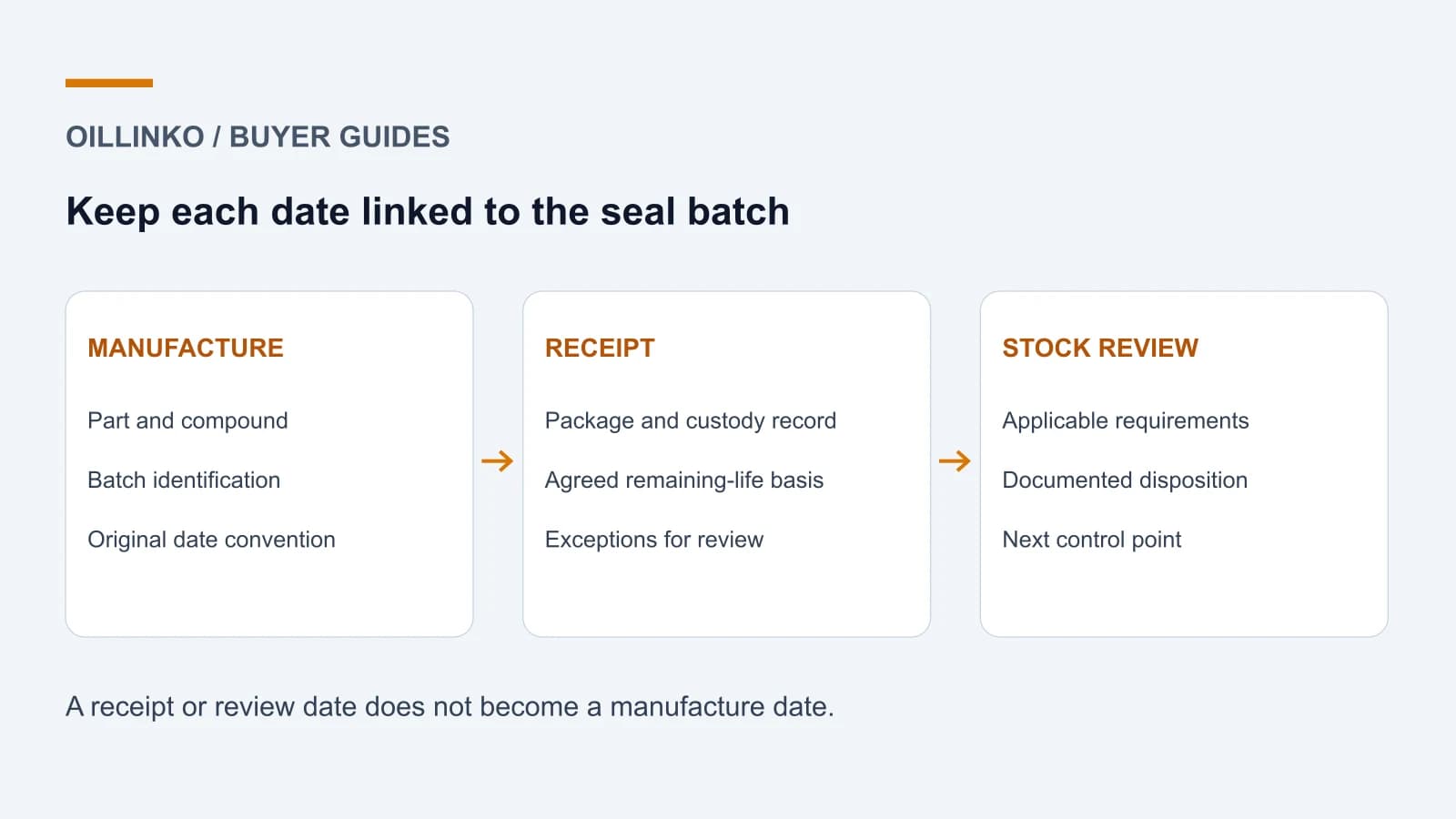
A box of spare seals can be the correct size and still arrive with an unresolved purchasing question: what evidence supports its age and remaining storage life? A recent invoice does not describe when the parts were manufactured, and a familiar material abbreviation does not identify every compound. Buyers need a record that connects the supplied part, batch, applicable storage basis and agreed acceptance requirement. That record should remain understandable after the shipment has been divided between maintenance teams or stores locations.
This guide concerns procurement and stock records before installation. It does not assign a universal expiry period or predict a seal's life in service. The current ISO 2230:2026 abstract covers inspection, recording, packaging and storage of rubber products before circulation. Its public description establishes the document's scope; it is not a substitute for the complete applicable specification. Use the edition required by the contract, resolve any outdated reference and obtain product-specific guidance where the basis is uncertain.
Identify the part and compound before comparing dates
Start the RFQ with the equipment or spare-part reference, seal drawing or dimensions, quantity and specified compound where known. Ask the bidder to identify the offered compound and product reference rather than quoting only a broad polymer family. Record whether the item is a loose seal, a bonded component or part of an assembled kit. Keep any proposed substitution visible as a separate offer. Similar dimensions or a shared hardness value should not silently replace the requested material identity.
Specify how the batch identification will appear on the package and accompanying records. For a kit containing several seals, ask whether one kit reference maps to multiple component batches and how that mapping will be supplied. An inventory system can then retain the kit identity while preserving the evidence for its contents. The elastomer hardness report guide explains a different acceptance question: how a reported test result relates to its sample and method. That evidence can support material review, but it does not replace the age record.
Separate manufacture, shipment and review dates
Ask the supplier to identify each date field and the convention used to express it. A code showing a quarter and year should remain recorded in that form unless its interpretation is confirmed. Do not invent an exact manufacturing day to satisfy a software field. Preserve the original code, its confirmed meaning and the calculation basis used for the purchase requirement. Receipt date and invoice date belong in the commercial record, but should not be substituted for the manufacturing information.
The storage guidelines in Trelleborg's Static Seals catalogue distinguish an initial storage period starting at manufacture from an extension period involving inspection and records. The procurement implication is to ask what each declared date represents. A supplier's review date should not be relabeled as a new manufacture date. If an offer states remaining shelf life without identifying the underlying rule or reference event, request that basis before comparing it with a competing offer that gives a fully identified batch and date.
Write a remaining-life requirement that can be checked
Agree the buyer's required remaining storage period and the event at which it must be satisfied. Possible contractual checkpoints include dispatch or receipt, but the RFQ should choose the intended one explicitly. Otherwise, two bidders can meet different interpretations of the same phrase. Identify the applicable product specification or manufacturer guidance and ask the supplier to disclose its offered age basis. Do not choose a percentage or number of years merely because it appears in an unrelated customer's purchase order.
Consider a maintenance project with delivery planned well before the intended shutdown. A batch that meets a dispatch requirement may need a different review by the time it is allocated for use. The buyer can make this visible by recording the planned receipt and use windows, without treating either date as guaranteed. If the schedule changes, review the stored items against the agreed controls. This example explains why the procurement record needs dates and responsibilities rather than a single unchecked shelf-life statement.
Keep packaging identity and custody evidence together
Define the packaging and labeling evidence expected at delivery, including the link between the part reference, batch and applicable storage information. Ask for any product-specific storage instructions to accompany the quotation or handover documents. If the supply chain includes repacking, clarify how original identification will be retained and who is responsible for the replacement label. A new outer bag should not erase the earlier batch identity or make the date history appear more recent than the supporting records establish.
Storage guidance addresses environmental exposure and deformation as well as elapsed time. For purchasing purposes, record the supplier's declared storage basis and any known departures instead of treating a calendar calculation as the whole acceptance decision. A practical custody record can identify the receiving location, package condition, transfers and reported exceptions. The export-packing RFQ guide deals with the transport package; keep that shipping scope coordinated with, but distinguishable from, the seal's continuing identification and storage requirements.
Route extensions and uncertain histories for review
An extension should be supported by the applicable technical basis and an identifiable review decision, rather than a warehouse label changed without explanation. Request the scope of the reviewed batch, the inspection or test evidence required by that basis, the decision date and the next control point. Trelleborg's guidance requires records when satisfactory items enter an extended period. Do not assume the same extension is available for every compound, component form, application or contractual requirement.
When evidence is incomplete, separate the commercial next step from the technical disposition. For example, record a missing manufacture-code interpretation as an open receiving exception and request clarification from the supplier. Preserve the original label photographs and documents so that the answer can be checked against the actual delivery. Do not describe uncertain stock as accepted while its status is unresolved. The authorized quality or engineering function should determine the appropriate disposition under the buyer's procedures and applicable product requirements.
Close the receiving record without implying service approval
A useful receiving record links the purchase line to the delivered quantity, part and compound references, batch identification, date basis, packaging observations and reviewed documents. Add any approved deviation and the person or function responsible for the decision. If a delivery contains several batches, retain separate entries rather than merging them into one convenient date. This makes future stock allocation and review easier, particularly when only part of a shipment is issued and the rest remains in storage.
Storage acceptance is one part of the replacement decision. Confirming records does not establish compatibility with the intended fluid, temperature, pressure or installation. Use the gaskets and sealing overview to organize the broader product enquiry, and submit the available specification through Oillinko's O-rings and packing page for manual review. The Oillinko homepage provides the wider sourcing context. Keeping identity, storage evidence and service requirements distinct allows a buyer to request the right clarification without overstating what any single certificate or label proves.