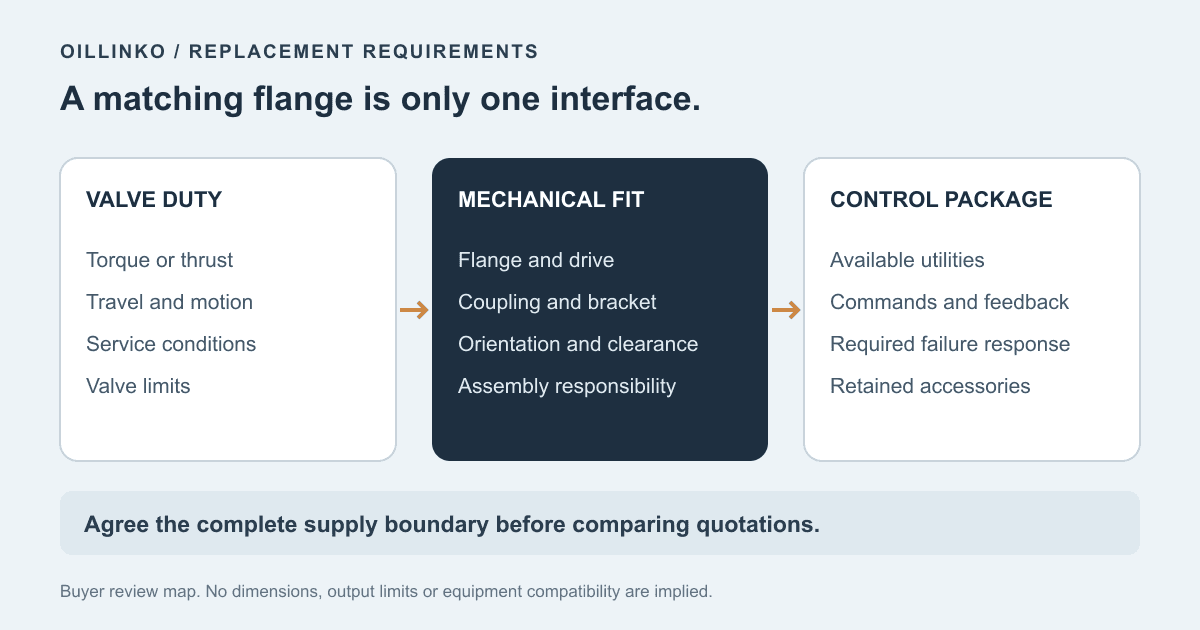
A valve actuator replacement can look straightforward when the old nameplate is readable and the mounting holes appear to match. Yet a replacement may fit physically while delivering unsuitable output, responding differently to a lost signal or requiring controls that the installation does not provide. A useful RFQ connects the valve, actuator and control package before a supplier prices an equivalent. That connection is especially important when the original model is discontinued or only part of the assembly will be replaced.
This guide helps buyers collect evidence for technical review. It does not prescribe actuator settings, spring changes or installation procedures. Start by deciding whether the purchase covers a bare actuator, an actuator with mounting kit, or a tested valve automation package. Those are different supply boundaries. Use the existing valves and actuation overview for the broader equipment families, then prepare the replacement-specific information below.
Identify what stays and what changes
Record the valve tag, manufacturer, model, nominal size, pressure designation and current service conditions. Identify the actuator separately, including its complete model code, serial number and configured options. Add available datasheets, assembly drawings and nameplate photographs. If a gearbox, stem extension or custom bracket sits between the actuator and valve, include its identification. A photograph can reveal the arrangement, but it cannot establish hidden dimensions or the actual valve operating requirement.
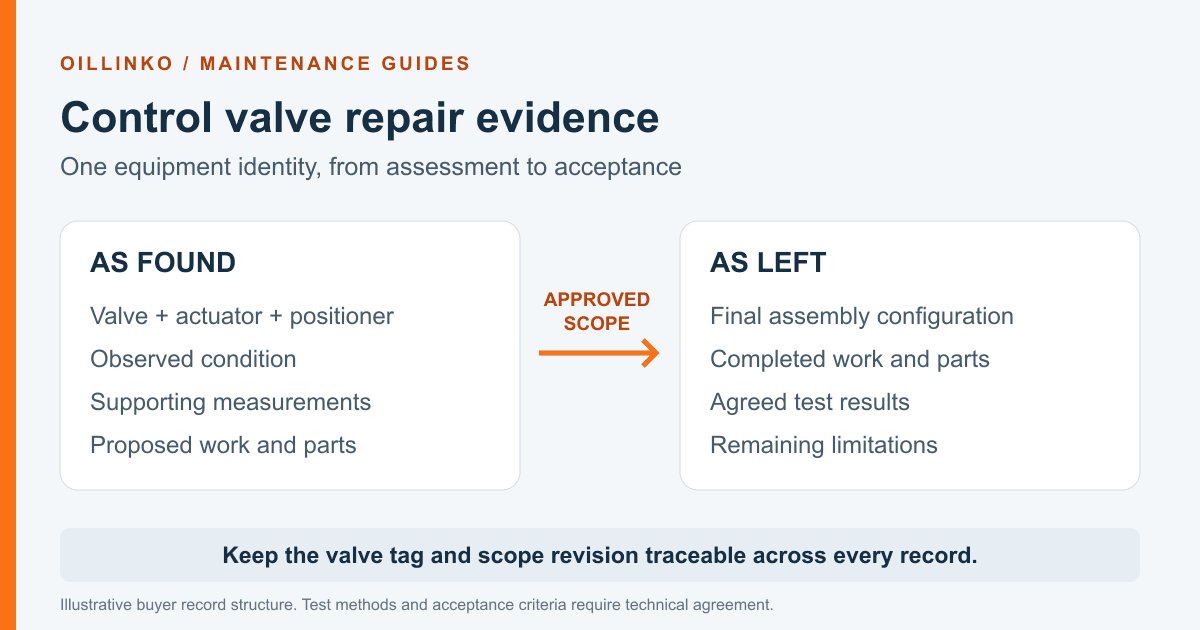
List the accessories that will be retained, replaced or supplied separately. A positioner, solenoid valve, limit-switch box, local panel or manual override can materially affect the package. Record changes made since the original purchase, including altered service or control requirements. If the condition of the valve itself is uncertain, resolve whether an assessment is needed. The control valve repair RFQ guide explains how to separate diagnosis from an authorized repair scope.
Request a sizing basis tied to the valve
Identify whether the valve requires part-turn, multi-turn or linear motion, and obtain the required travel and operating output from its manufacturer. For rotary equipment, torque requirements can differ across the opening and closing strokes. Do not replace that information with the old actuator's maximum nameplate output. Bray's ball valve actuator selection bulletin illustrates why seat material, service, pressure and operating frequency enter its product-specific sizing assessment. Its tables and factors are not universal values for other valves.
Require the proposed actuator's output to be checked across the relevant travel and supply conditions. A spring-return unit needs attention to the powered and spring strokes; Bray's bulletin explicitly treats both in its selection example. Ask the supplier to identify assumptions, applied margins and the source of the valve data. A quotation stating only that an actuator is oversized leaves those questions unanswered. Linear equipment requires its own thrust and stroke assessment rather than a rotary torque comparison.
Also obtain the valve's applicable mechanical limits. Bray's Series 98H sizing manual identifies maximum allowable stem torque, or MAST, and the minimum available pressure used for sizing. These illustrate two separate concerns: producing enough output at the stated supply and respecting what the driven assembly can accept. Ask the responsible engineer and supplier to demonstrate both for the proposed package. Do not choose an arbitrary safety factor or assume that the largest available actuator is automatically the safest replacement.
Check the complete mechanical interface
ISO 5211:2026 covers part-turn actuator attachments, including flange and driving-component dimensions and interface torque references. Its published scope excludes the attachment of an intermediate support to the valve. Consequently, quoting an ISO mounting designation does not settle the complete installation. State the applicable edition and request an arrangement drawing identifying the valve, coupling, bracket, gearbox if present, and actuator. Control-valve attachments under this document require agreement between purchaser and supplier.
Confirm the drive shape, engagement dimensions, orientation, required rotation or travel and mounting hardware through approved drawings. Include clearance around nearby piping, insulation and structures, together with access needed for the specified manual operation and servicing. Assign responsibility for checking the mounting assembly and support loads. Where dimensions are unavailable, request a defined survey or engineering review before accepting a direct-fit claim. Keep that work separate from assumptions made from an unscaled photograph or an old catalogue sketch.
Match utilities, signals and accessories
Describe the supply actually available at the equipment. For pneumatic or hydraulic systems, provide the specified medium and available pressure range, together with project requirements for its condition. For electric actuators, state voltage, phase, frequency and control supply where applicable. Ask the supplier to disclose relevant power or flow demand. An actuator selected around a nominal utility value may require further review if the actual guaranteed supply is different. Record unresolved utility information as a quotation qualification.
Document commands, position feedback, local and remote operation, communications and the interface to any existing positioner or controller. Provide the relevant wiring and pneumatic diagrams for comparison. Similar connector appearance or a shared signal description does not prove that the complete control arrangement is interchangeable. Include ambient conditions, ingress protection and the project's hazardous-area requirements. Request applicable documentation for the actual offered configuration and accessories rather than relying on a general certificate covering an unspecified product family.
Define failure response and operating duty explicitly
Write the required valve response for loss of motive supply, control power and command signal as separate scenarios. Do not assume those events produce the same result. Rotork's RH product description lists double-acting and spring-return configurations, fail-open or fail-close arrangements, and on/off or modulating applications. That variety shows why a range name alone is incomplete identification. Ask for the offered configuration and supporting control diagram; the cited product features are not a recommendation for an unreviewed application.
Obtain the required failure behavior from the approved process and control basis. A buyer should not choose a safe position from the valve's location or presumed purpose. State required travel times, operating frequency and whether the duty is occasional isolation or continuing modulation. Any emergency or safety-related function needs review of the complete arrangement by the responsible team. Product claims alone do not establish that an installed function meets the project requirement, and a faster replacement is not automatically an acceptable change.
Make the quotation and acceptance package reviewable
Request the full proposed model code, sizing assessment, interface drawing, accessory list and explicit deviations. Separate supply, assembly, testing, installation and commissioning responsibilities. Agree which functions will be demonstrated before dispatch and what remains to be verified at site under approved procedures. The third-party inspection guide helps define witness responsibilities and reporting. Keep the accepted drawings and configuration records connected to the actual equipment identifiers so receiving personnel can check what was supplied.
Include quantity, required delivery date, destination, documentation needs and whether alternatives are permitted. Compare quotations on the same assembly boundary, including any mounting kit, accessory replacement or engineering work. Send the evidence through the actuators and positioners enquiry page or submit an actuator replacement RFQ. Oillinko reviews requirements and coordinates enquiries manually with suitable providers. Availability, technical suitability, manufacturer support and commercial terms are confirmed for the specific request.
Frequently asked questions
Does matching ISO 5211 mounting make an actuator interchangeable?
No. The attachment is one interface. Confirm the drive connection, mounting assembly, output throughout travel, valve limits, utilities, control signals and required failure response before accepting a replacement.
Can I select a replacement from the old actuator nameplate alone?
The nameplate helps identify the installed unit, but the supplier also needs the valve duty, required operating output, mounting arrangement, available supply and control requirements. Ask for a documented replacement assessment and disclose any changes since the original installation.
What should the replacement actuator quotation include?
Request the complete model code, sizing basis, interface drawing, retained and new accessories, wiring or pneumatic diagrams, agreed testing, applicable documentation and explicit deviations. Clarify responsibility for assembly and site commissioning.