
Pressure Vessels, Tanks & Heat Exchangers
Coriolis Flowmeter Replacement RFQs: Process, Fit and Signal Interfaces
Treat the flow sensor and its connected measurement chain as one enquiry.
By OillinkoPublished Updated 7 min read
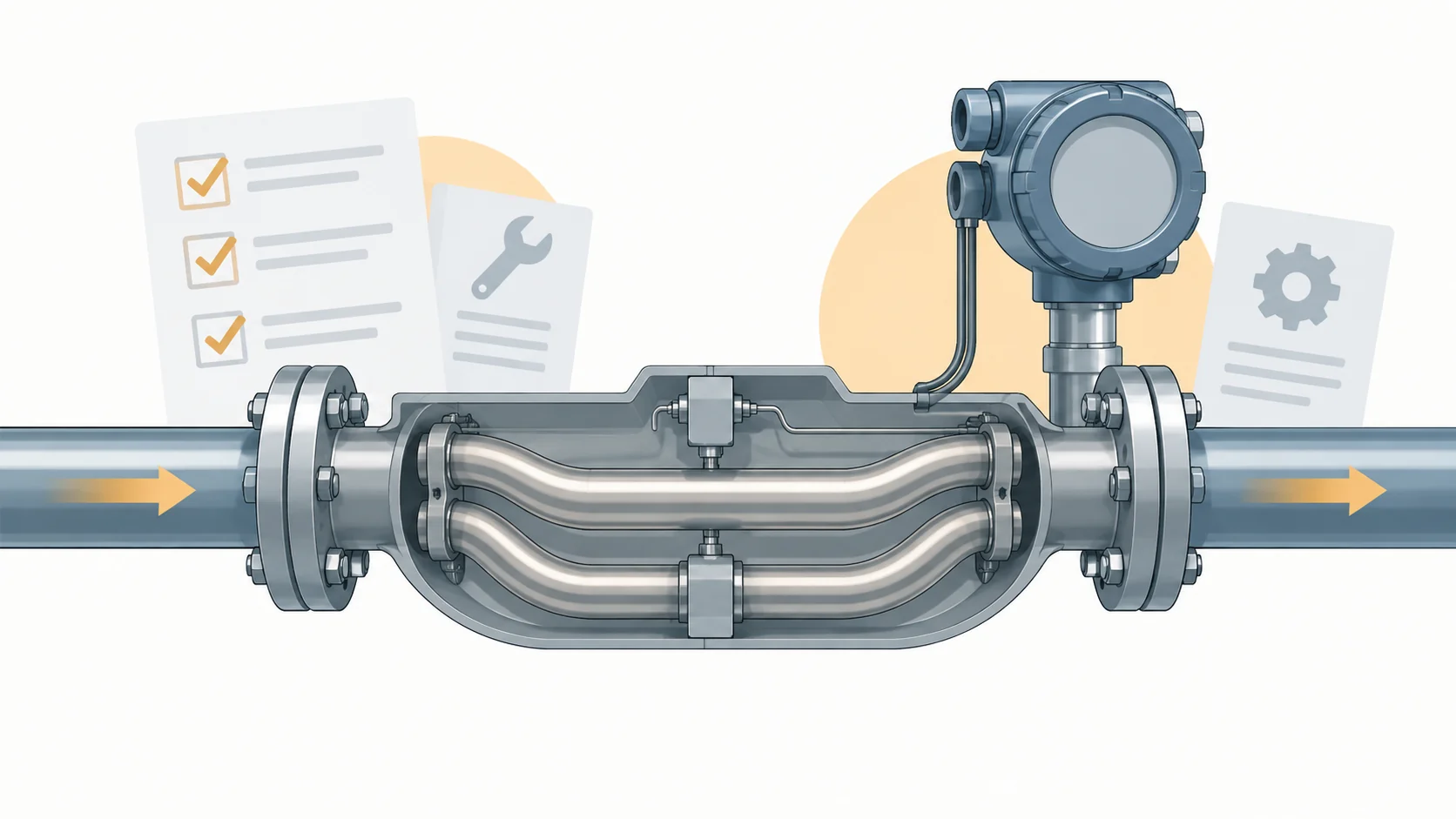
A Coriolis flowmeter replacement enquiry needs more than a pipe size and a photograph of the old display. The buyer must identify the measured duty, the actual process envelope, the sensor and transmitter supplied together, the mechanical connection and the signal expected by the control system. A quotation that matches only the nominal line size can conceal a different measuring range, pressure loss, output configuration or approval boundary. Treat the replacement as an instrument assembly connected to a specific process and control loop.
This guide is for preparing a technically reviewable RFQ, not for selecting a meter or changing a live process. The responsible instrument and process engineers must approve the actual application. Preserve unknown data as questions, ask each bidder to document the offered configuration and keep alternatives separate from an exact replacement. An installed part number helps identify the baseline, but it does not prove that the earlier selection remains suitable after process or control-system changes.
Identify the measurement purpose
Endress+Hauser's explanation of the Coriolis principle describes direct mass-flow measurement and the ability of suitable instruments to derive other process values, including density. That general principle does not mean every transmitter supplies every value or meets every project accuracy target. State which outputs the application actually uses: mass flow, density, temperature, calculated volume or a total. Mark which values are for indication, control, batching or commercial measurement.
For a replacement, provide the instrument tag, existing sensor and transmitter references, serial or order identifiers where available, loop drawing, approved datasheet and the latest configuration record. Identify whether the sensor, transmitter, display, cabling or mounting hardware will be retained. Ask bidders to show a complete itemized supply boundary. If a proposed alternative changes how a value is calculated or communicated, the comparison must flag that change for technical approval rather than describe it as a direct equivalent.
Give a real process envelope
List minimum, normal and maximum flow with units and the duration or operating mode associated with each case. Provide the fluid identity, composition where known, density and viscosity information, operating and design pressure and temperature, and any cleaning or upset cases defined by approved documents. Different phases or intermittent gas entrainment should be identified explicitly. Do not fill an empty datasheet with a guessed water value merely to obtain a model recommendation.
The Emerson flowmeter overview identifies fluid, flow rate, pressure, temperature and required accuracy as selection inputs. For the exact offered sensor, request a sizing calculation across the relevant range, including expected pressure loss and any application limits. Keep pipe bore distinct from sensor sizing. The purchaser should compare the proposed pressure loss with the available process allowance instead of assuming that a same-size flange gives the same hydraulic behavior.
Check fluid behavior and evidence
Identify the expected single-phase or variable-phase conditions without assuming that a generic performance statement applies to all mixtures. The manufacturer's discussion of entrained gas in Coriolis measurement illustrates why the actual fluid condition matters to accuracy and stability. If gas, solids, rapid composition changes or empty-full cycles are possible, give the operating cases and ask the bidder to state what performance can be supported for its selected model and configuration.
Specify the project-required measurement performance and the conditions to which it applies. Request the manufacturer's supporting datasheet and relevant application assessment, separating reference-condition accuracy from installed performance. Define the calibration or verification evidence required for the new assembly and whether any site check is part of the offer. A certificate for a sensor alone may not answer questions about the transmitter, configuration and output used by the actual loop. The calibration certificate guide gives a complementary way to read measurement evidence without treating a certificate as universal application approval.
Map the mechanical and environmental interfaces
Supply the current line drawing and the available installation envelope. Specify the connection standard, size, pressure class, facing or end preparation, face-to-face length, material requirements and any mating-component constraints. Identify support arrangement, access for removal, insulation and environmental exposure. Ask for a controlled dimensional drawing of the offered sensor. A nominal pipe size cannot establish that the proposed assembly fits the existing spool, support or maintenance clearance.
Request a material schedule for process-wetted parts and pressure-containing components, plus the applicable manufacturing and documentation requirements. Do not infer compatibility from a broad stainless-steel label. Any hazardous-area or electrical approval must be checked against the exact offered model and installation requirement; an approval for a related catalogue variant is insufficient. Give the area classification and project specification where relevant and ask the bidder to identify both evidence and exceptions. Installation suitability remains a project engineering decision.
Keep the signal chain visible
Describe the power supply, required outputs, communication protocol, pulse or frequency use, alarm behavior and the receiving control system. Include any existing cable route and length constraints, remote-versus-integral transmitter arrangement, display requirements and the loop's configured units and scaling. Request a wiring and configuration schedule for the offered assembly. A transmitter with a familiar-looking housing does not establish that the plant will receive the same values in the same format.
For replacement work, distinguish a physically compatible sensor from a drop-in control-system replacement. Ask the bidder to document required software, communication modules, configuration conversion and commissioning support as separate inclusions or exclusions. Retain the accepted configuration revision in the handover package. If the proposal changes a custody-transfer, batching or safety-related measurement chain, refer the entire change to the authorized project reviewers rather than promising functional equivalence in the RFQ.
Compare quotations on one basis
Build a comparison table with the duty cases, offered sensor and transmitter references, measured values, selected range, sizing basis, pressure loss, connections, dimensions, materials, approvals, calibration evidence and signal interfaces. Add delivery scope, documentation and stated manufacturing origin. Origin is the country where the offered item is made, not the location of the sales office or dispatch warehouse. Record unknowns and deviations by line; a low price for a sensor alone is not comparable with an assembled and configured meter.
Provide the old datasheet, process cases, P&ID, piping drawing, loop diagram and required evidence list with the enquiry. Use the flow-meter catalogue enquiry page to send the controlled requirement to Oillinko for manual review and routing. The Oillinko home page explains the wider equipment and service scope. This guide does not establish inventory, an approved substitute, a particular manufacturer relationship or a guaranteed delivery term; each offer needs its own documented review.