
Logistics & Delivery
Commercial Invoice, Packing List and Origin Certificate: Reconcile an Equipment Shipment
Three shipment records answer different questions and should agree at item level.
By OillinkoPublished Updated 9 min read
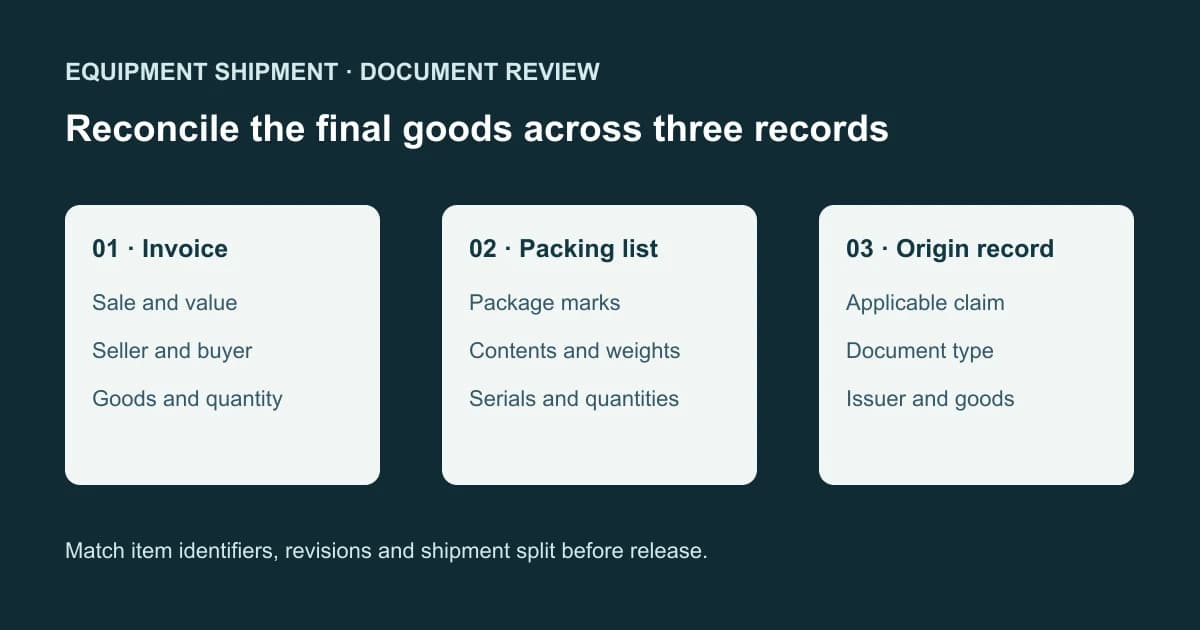
Before an equipment shipment is released, compare the commercial invoice, packing list and any required certificate of origin against the same final goods. The invoice explains the sale and declared goods; the packing list explains the physical packages and contents; an origin document addresses the stated origin under the applicable requirement. They serve different purposes. Matching totals at the document header is not enough if one crate contains a substituted item, a changed serial number or a quantity that appears on only one record.
This is a buyer's document-reconciliation guide, not customs or legal advice. The importer, freight forwarder and responsible customs adviser should confirm the exact forms, issuers, languages and destination rules before dispatch. Start those questions while preparing the RFQ. If an origin certificate is required, identify whether it is a general non-preferential document or a specific preferential proof, because the two should not be assumed interchangeable. Do not promise a shipment date from an incomplete draft document set.
What the commercial invoice should answer
The invoice identifies seller and buyer, describes the goods and records the commercial value and currency. It should connect to the actual purchase order and agreed sale terms. The US International Trade Administration's export-document guide explains that customs commonly uses the commercial invoice in valuation and that destination governments may prescribe additional content. For an equipment buyer, the immediate review is factual: are the descriptions, line quantities, model identifiers and seller details consistent with the accepted offer?
A pro forma invoice used during quotation is not automatically the final commercial invoice. If a project changes quantities, supplier, manufacturing origin or delivery terms between award and dispatch, ask for the final invoice to reflect the agreed configuration. Keep price and payment fields within the authorized commercial process; the article does not set a price or recommend a customs value. A revised invoice should have a clear version and date so the logistics team does not pair it with an older packing list.
What the packing list should answer
The packing list should let a receiver locate each ordered item and accessory in a numbered package. Compare package marks, crate or carton count, quantities, descriptions, gross and net weights and dimensions with the final physical packing. The same US government guide notes that a packing list is more detailed about the packages and is not a substitute for an invoice. For a serialized unit, request the package number tied to the exact serial or tag. For loose spares, identify their containing package and line item.
Weights and dimensions may change when the final crate design is agreed. Label preliminary estimates as such and request a final list before booking or release. If one purchase order becomes two shipments, each list should show what actually travels in that shipment; a complete order quantity on both lists would be misleading. The export-packing RFQ guide addresses preservation and package design. This page focuses instead on reconciling the finished paperwork with the final goods.
What an origin document should answer
A certificate of origin, where required, should relate to the invoiced goods and the applicable origin claim. The International Chamber of Commerce overview describes its role in documenting product nationality for customs or trade requirements. Check the named goods, quantities, issuer and document type against the importer's stated need. An origin statement on an invoice may not replace a separately required certificate. Conversely, do not request an unnecessary certificate simply because it appeared in another project's document list.
Country of manufacture, customs origin, seller location and dispatch point can differ. Do not copy the seller's address or airport of departure into an origin field. The country-of-origin versus dispatch guide examines those four locations. Where a submitted non-preferential certificate is issued by a participating accredited chamber, the ICC verification explanation describes a route for checking authenticity. Availability of that route depends on the issuing chamber; a missing online result alone is not a determination of false origin.
Reconcile by line, package and shipment
Use one comparison table with purchase-order line, final item description, quantity, serial or tag if applicable, invoice line, package number, packing-list line and origin document reference. Reconcile each row, not only grand totals. If a valve and actuator are quoted as one package but invoiced separately, explain the relationship so the receiver does not treat one component as missing. If several factories supply identical spare-part descriptions, retain the batch or serial mapping needed to support each origin claim. Ask the supplier to resolve mismatches before the documents are finalized.
A practical example is a two-crate shipment containing one skid and its loose instruments. The invoice may show one skid line and the instrument accessories under the same sale. The packing list should identify which crate contains the skid and which contains the loose items, with identifiers that connect back to the order. If an origin document describes only the skid, the importer needs to decide whether the accessories are adequately covered or need a separate declaration. This is a comparison example, not evidence of an actual Oillinko shipment.
Record who prepared each document, the final revision and the date checked. Provide the importer and freight forwarder enough time to confirm local requirements before cargo handover. Keep transport documents and any required conformity or inspection records in the same controlled package, but review their distinct purposes separately. The multi-vendor shipment guide covers additional reconciliation when different sellers contribute to one movement. Do not merge separate manufacturers into one undocumented origin claim for convenience.
For an equipment enquiry, send the destination, expected shipment split, item identifiers and required document list through Oillinko's freight and project logistics enquiry page. Oillinko can review the scope and route the request manually. The responsible importer and specialists should confirm the legal customs treatment and final acceptance of each document for the actual transaction.