Spiral wound gasket identification starts with a practical problem: a stores description such as “4-inch, Class 300, stainless steel and graphite” can leave several purchasing decisions unresolved. Which metal is the winding? Is there an inner ring, and what is it made from? Which flange arrangement must the gasket fit? Two offers can repeat that short description while proposing different constructions. A buyer needs to resolve those differences before treating the prices as comparable.
This guide explains how to turn available markings and engineering records into an identifiable replacement requirement. It concerns static spiral wound gaskets, not pump mechanical seals or machined ring-joint gaskets. Start with the approved joint specification and use the old item as supporting evidence. An unidentified gasket found in stores is not, by itself, proof of the construction required by the installed equipment.
Separate four material fields in the enquiry
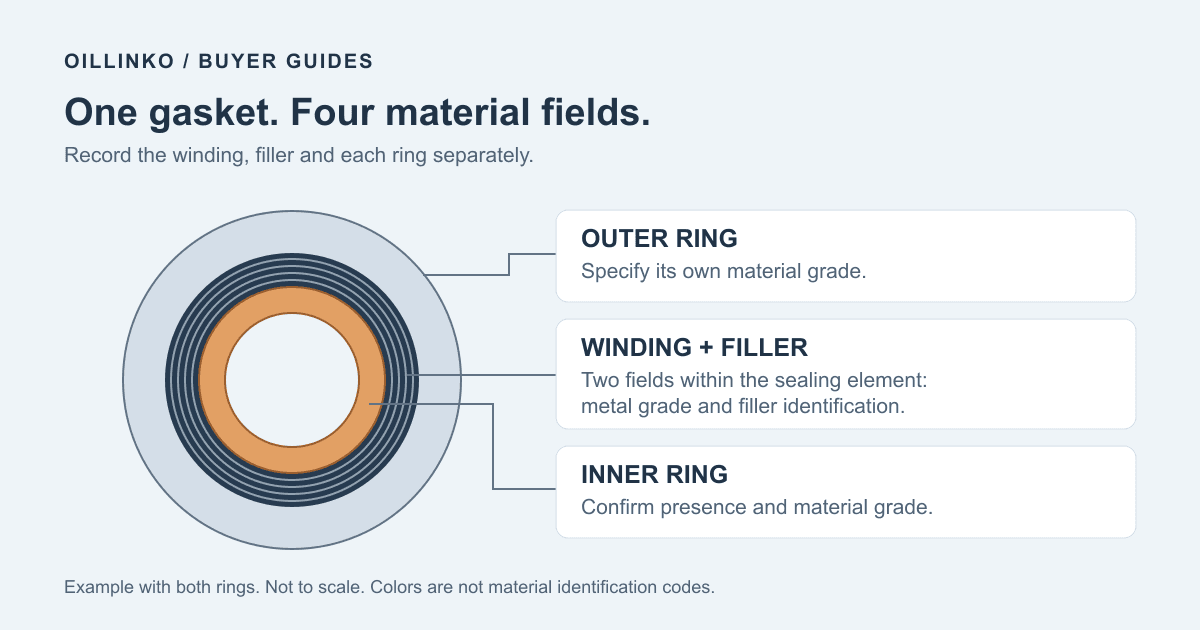
A spiral wound sealing element combines a metal winding with a softer filler. Depending on the specified design, it can also have an outer centering ring and an inner ring. These are distinct components, not interchangeable names for one metal part. Garlock's 2019 metallic gasket manual, pages 5 and 9 illustrates the construction and distinguishes winding, filler and ring information when ordering. Its product descriptions are manufacturer references, not a declaration that every gasket has the same arrangement.
Give each component its own field in the purchase description. For example, “316L winding, graphite filler, inner ring material to be confirmed, outer ring material to be confirmed” exposes the missing decisions. It is more useful than silently extending the winding grade to both rings. Ask the supplier to return a fully populated construction description and flag deviations against the project requirement. Do not approve a blank field by assuming that a familiar catalogue style supplies the answer.
Use markings to identify, then verify the record
Obtain readable photographs of the complete gasket, its permanent markings and the package label. Record the manufacturer, visible size and class designation, material abbreviations, product reference and any batch information exactly as found. Keep an uncertain character marked as uncertain; a guessed letter in an alloy or part designation can send the enquiry toward a different item. If the markings conflict with the stock record, ask for technical clarification before choosing either as authoritative.
The same Garlock manual shows guide-ring edge colors and stripes for material identification on page 24. Such markings are helpful cues, but a colored ring should not replace the complete product record. Paint condition, lighting and an incomplete photograph can make an apparent match unreliable. Ask the proposed manufacturer to interpret its markings using the applicable current guide. Confirm which component each material abbreviation describes, and retain the written clarification with the quotation rather than relying on a verbal identification.
Identify the flange standard, facing and bore
ASME B16.20-2023 covers materials, dimensions, tolerances and markings for specified metallic gasket types. Its reference flange standards include ASME B16.5 and B16.47. Naming B16.20 alone does not fully describe the mating connection or establish service suitability. State the applicable project edition, flange standard, nominal size, class and facing. Where B16.47 applies, identify the required series. Resolve incomplete flange records with the responsible engineer instead of selecting a dimension table by appearance.
Flange type and bore deserve their own check. Garlock's 2015 bulletin on flange types and spiral wound gaskets explains how a larger bore can leave part of a gasket unsupported in some arrangements. Its practical implication for an RFQ is to include the flange type, pipe schedule or confirmed bore, and available joint drawing. The bulletin is background, not a current dimensional approval for your joint. Have the proposed gasket checked against the applicable standard, manufacturer information and actual mating geometry.
Make ring configuration and service review explicit
Specify whether the required construction has an inner ring, an outer ring or both, with the approved drawing or manufacturer reference where available. If an offer substitutes a different ring arrangement, record it as a technical deviation. The buyer should request the reason and obtain the appropriate engineering decision. A shorter lead time or a similar-looking gasket does not establish equivalence. Keep any approval tied to the particular line item and service rather than applying it across all spares.
Attach the service information needed for material review: process medium, relevant concentrations, operating and design conditions, and any specified cleaning exposure or cycling. Identify project restrictions on fillers, metallic grades or approved products. Request written confirmation for the proposed construction under those stated conditions. A broad label such as chemical resistant, high temperature or fire safe is not a substitute for the applicable technical evidence. This enquiry guide provides no universal material limits or tightening settings.
Compare dimensions without guessing from a used gasket
Use a controlled drawing when the gasket is nonstandard or equipment-specific. Distinguish the sealing element dimensions from the inner-ring opening and the outer-ring diameter, and identify the required thicknesses and tolerances. A single unlabeled inside or outside diameter can describe the wrong feature. Ask the supplier to mark its proposed dimensions on a drawing using the same reference points as the enquiry. Measurements from a used or distorted sample need engineering interpretation.
When comparing offers, keep the quoted part number, drawing revision, complete materials and declared exceptions together. If one supplier groups multiple requested size/class items under one stock code, ask it to explain the dimensional basis and have that grouping reviewed. Do not assume universal interchangeability, or universal incompatibility, solely from the class labels. The flanges, gaskets and bolting guide provides the wider context for reviewing the connection as an assembly.
Carry the identification through to receiving
Specify quantities as individual gaskets or clearly defined sets, and ask for packaging labels linked to the purchase line. Agree the required material and conformity records before placing the order. The EN 10204 material document guide helps distinguish document types; it does not mean every gasket automatically requires the same certificate. Ask how any requested evidence will identify the supplied components or batch. State manufacturing-origin requirements separately from the supplier's dispatch location.
At receiving, compare the agreed description, markings, quantities and documentation, and record visible damage or discrepancies through the project's acceptance process. Retain item identity when packaging is opened or spares are separated for different assets. For sourcing, send the confirmed fields and clearly marked gaps through Oillinko's spiral wound gasket requirements page or submit a gasket enquiry. Requests reach Oillinko for manual review and supplier coordination; the offered product, availability and supporting records are confirmed against the specific enquiry.
Frequently asked questions
Is a spiral wound gasket identified by size and class alone?
No. Confirm the flange standard and facing, gasket construction, winding and filler, inner and outer ring materials, and applicable dimensions or drawing. The flange type and bore can also affect the suitability of the selected gasket.
Does 316L describe every metal component in the gasket?
Not necessarily. A description may refer only to the winding. Specify the winding, inner ring and outer ring separately, and ask the supplier to identify each component in the offered construction.
Can I order a replacement from the gasket color?
Use color as a supporting identification cue, then check the manufacturer's current marking guide, permanent markings and purchase records. A photograph or color alone does not establish the complete construction or suitability for the service.