
Piping, Flanges & Fittings
Metal Bellows Expansion Joint RFQs: Movement, Restraints and Interfaces
A buyer guide to linking expansion joint movements, service conditions and piping interfaces.
By OillinkoPublished Updated 7 min read
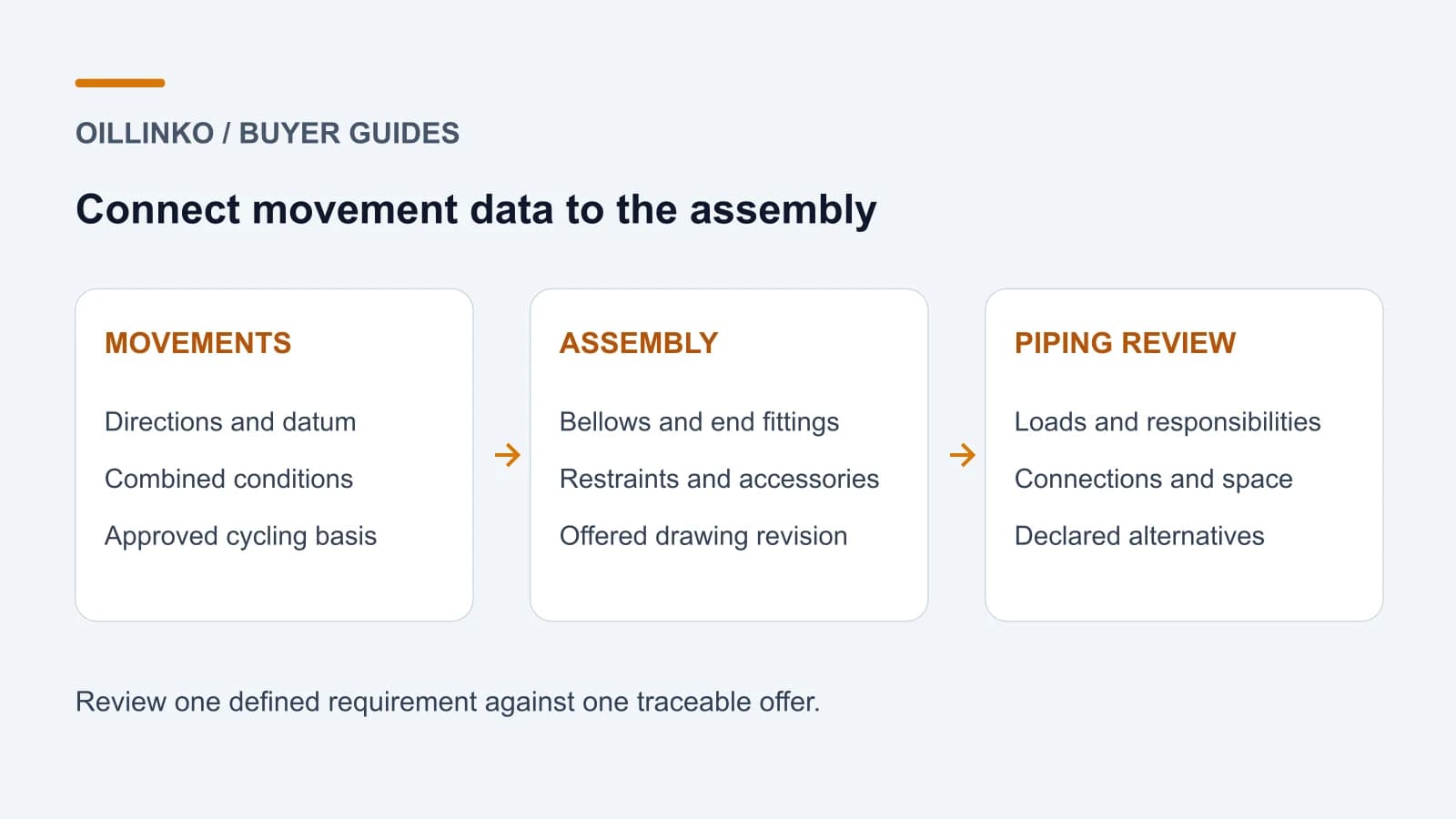
A metal bellows expansion joint RFQ needs a defined assembly, movement requirement and piping interface. Diameter and flange class describe only part of the purchase. Two assemblies that fit the same bolt pattern can have different movement capabilities and restraint arrangements. Before comparing prices, establish who provides the piping design information, who selects the joint and who reviews the loads and interfaces that the proposed assembly places on the surrounding system.
For a replacement, collect the equipment tag, original drawing, installed dimensions and any available design records. Photographs help identify external features, but they do not establish the design of the bellows hidden beneath a cover. State whether the enquiry is for a complete replacement, a bellows element or an alternative assembly. A supplier should identify the offered boundary rather than assume that every visible component will be retained or replaced.
Define the assembly boundary
The EJMA explanation of bellows construction describes a flexible corrugated element connected through end fittings. It distinguishes axial extension and compression, lateral offset and angular rotation, and warns about torsional movement. Those distinctions give a buyer useful names for the required motions. They do not determine the permissible movement of the offered product; that must come from its reviewed design and application data.
Give each assembly a separate RFQ line, with a drawing reference and revision. Identify the bellows, end fittings, connecting pipe sections, restraints, liners and covers that belong within the supplied scope. If an existing item has no readable identification, describe that uncertainty and request an assessment rather than claiming an exact replacement. A proposal based on an unknown assembly should remain conditional until the missing design and interface information has been resolved.
Describe movements as a defined set
Ask the responsible piping engineer to provide the required movements, units, directions and reference condition. Distinguish installation position from operating displacement and identify which movements occur together. An axial value and a lateral value in separate columns should not silently become permission to apply both at their individual maxima. The bidder should state how the supplied movement information has been interpreted and identify the combination for which the assembly is proposed.
Include the approved operating scenarios and cycling requirement where these are known. For example, a joint serving equipment with frequent temperature changes may need a different review from one whose principal movement occurs during occasional start-up. The purchaser should supply the project basis without selecting a generic cycle-life number from an explanatory website. If settlement, misalignment or vibration is part of the enquiry, keep that requirement identifiable for engineering review rather than calling every displacement thermal expansion.
Keep service conditions with the movement data
State design and operating pressures and temperatures, the fluid, and any specified vacuum or external-pressure condition. Identify transient cases already defined by the project and reference their approved documents. Request the proposed materials for the bellows and other relevant parts. A familiar stainless designation is not enough to approve an assembly for an incompletely described medium, and a pressure rating stated without its associated temperature does not provide a complete comparison.
Provide available flow and fluid information for the bidder to assess accessories such as a liner. Keep an accessory recommendation tied to the actual application and drawing. Do not infer that a liner is included because it appears in a product photograph. Similarly, describe insulation and exposure requirements as project inputs. The technical response should list what is supplied, what application information was used and what remains outside the assessment.
Make restraints and piping responsibilities explicit
EJMA distinguishes tie rods that restrain pressure thrust and prevent axial movement from limit rods that allow a specified axial capability. Record the proposed arrangement explicitly; similar external rods need not perform the same function. Ask the bidder for the loads and restraint information required by the piping reviewer. The enquiry should also identify responsibility for anchors, guides, supports and connected equipment. Their adequacy requires system engineering, beyond matching an expansion joint to a nominal diameter.
An alternative that changes the restraint arrangement needs a separate technical review even if its purchase price is lower. Ask for a marked drawing showing the difference from the requested assembly and the assumptions requiring confirmation. Keep temporary shipping devices distinct from permanent operating components in the documentation. This article does not prescribe anchor sizes, guide spacing or installation procedures; the reviewed assembly instructions and approved piping design govern those matters.
Check physical interfaces and access
Specify end connection type, standard, size, facing and material, together with the installation length and dimensional datum. For welded ends, provide the approved connection detail and adjoining pipe information. The pipeline fittings and schedules guide helps organize that interface data. A measured face-to-face dimension should be accompanied by the condition in which it was measured, so the bidder can distinguish an installation observation from a specified design dimension.
Use the flange pressure-class guide when recording flange requirements, while keeping the assembly rating separately reviewable. Include available space for covers, restraints and adjacent equipment, plus photographs with a reliable scale where drawings are incomplete. Ask for the offered overall dimensions and orientation features. Treat pipe modifications and access changes as declared work, rather than discovering them after a supposedly direct replacement arrives.
Agree the evidence before comparing offers
Request the approval drawing, identified design basis, relevant material records and the inspection or test documents required by the purchase specification. The EJMA standards website identifies its design publication; a public overview is not access to the normative standard. Specify the project edition and required evidence explicitly. Ask the supplier to relate its documents to the actual assembly reference, quantity and manufacturing origin.
A comparison sheet should show the requested and offered movements, service conditions, materials, connections, restraint arrangement, accessories and exceptions. Include the drawing revision and the status of unresolved questions. If a bidder supplies only an indicative proposal pending piping data, preserve that limitation. An unqualified compliant statement should not replace the information that allows the project reviewer to establish whether the proposal fits the defined requirement.
Prepare an enquiry that can be reviewed
Keep the delivery scope and commercial exclusions beside the accepted technical configuration. Clarify whether documentation review, inspection attendance, packing and any installation support are included. For a combined flexible-assembly request, the industrial hose assembly RFQ guide covers the different information needed for hoses. Do not treat a hose and a metallic bellows assembly as interchangeable simply because both are described as flexible piping components.
Send the controlled tag list, application data, drawings and required records through Oillinko's industrial hoses and expansion joints equipment page. Oillinko coordinates enquiries for manual review and sourcing. When the piping basis is incomplete, identify the assessment needed before a firm comparison. The resulting purchase should refer to the reviewed assembly and its documented interfaces, with system design responsibility and any alternative arrangement clearly recorded.