
Pressure Vessels, Tanks & Heat Exchangers
Connect process duty and measurement.
Read moreRead less about this category
Distinguish storage, separation and heat transfer
Pressure vessels, storage tanks and heat exchangers can appear together on a process equipment list, but they are selected for different duties. A vessel may separate phases or provide a controlled process volume; a tank may hold inventory; a heat exchanger transfers heat between streams. The equipment boundary, design basis and supporting documents therefore differ. This category helps buyers frame those differences before asking for a quotation. It connects to the existing vessel and tank catalogue and the published guide to vessels, tanks and heat exchangers.
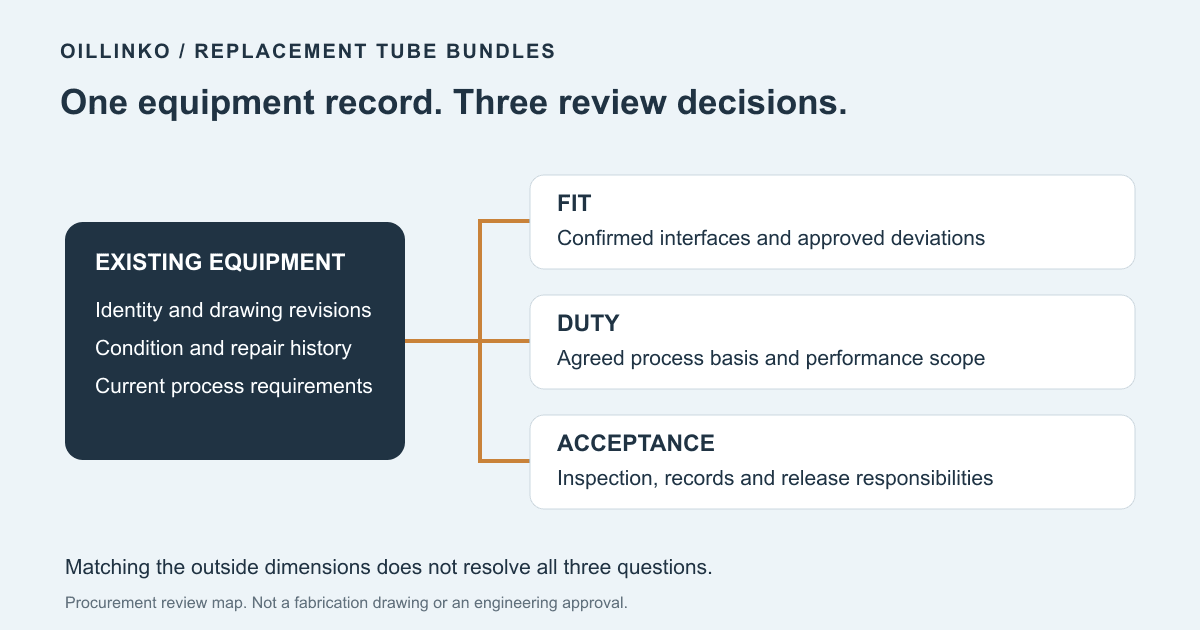
Begin with the process purpose and identify whether the requirement is for a complete fabricated unit, an internal component or an accessory for installed equipment. A replacement level instrument is not the same enquiry as a complete tank monitoring package, and a tube bundle is not necessarily interchangeable with another bundle having similar outside dimensions. For installed equipment, supply the nameplate, original drawing, equipment number and revision history. Describe which items are available for inspection and which dimensions still need confirmation, so the supplier can distinguish established facts from information to be developed.
Describe operating cases and usable capacity
Vessel and tank enquiries need more than a nominal volume. The process engineer should define the required working capacity, pressure and temperature conditions, fluid properties and relevant operating cases. Design conditions, normal operation and occasional cleaning or upset conditions should be clearly distinguished. If separation is required, describe the incoming phases and the expected outlet requirements. Avoid converting a broad separation objective into a guaranteed performance value without a process basis. The supplier needs agreed feed information and acceptance criteria to explain the proposed equipment and any limitations.
For heat exchangers, identify both fluid streams, their required inlet and outlet conditions, flow rates and allowable pressure losses. Utilities such as cooling water or steam need their own operating information. Space, access, fouling considerations and maintainability can influence the arrangement as well as heat duty. A thermal offer should identify its calculation basis and exclusions. Ask which conditions were assumed and what happens if the available utility differs from that basis. The buyer's comparison should include these assumptions rather than ranking exchangers solely by quoted surface area or overall weight.
Agree the fabrication and interface boundaries
For installed exchangers, the replacement tube bundle RFQ guide explains how to connect drawing revisions and retained interfaces to the process basis. It separates mechanical fit, performance commitments and acceptance evidence before a manufacturing order is released.
Fabricated equipment often has many mechanical interfaces. Nozzle orientation, connection details, supports, lifting provisions and access openings should be represented in the agreed drawing package. The surrounding piping and structural design must account for the equipment arrangement and project requirements. If transport dimensions restrict a package, establish whether field assembly is expected and who is responsible for that work. A quotation for shop fabrication may exclude site lifting, foundation work, insulation, coating repair or final connections. These exclusions affect both project cost and the schedule needed to reach a usable installation.
Internal components deserve explicit identification. Demisters, distributors, trays, coils and other internals may have their own material and performance requirements. Existing internals can also restrict what can be replaced through an access opening. For spare components, include the equipment serial number, assembly drawing and part identification where available. Ask the manufacturer to confirm fit and the scope of any replacement proposal. A dimensional resemblance is useful evidence for an enquiry, but it does not establish that a component will maintain the original vessel's process performance or design requirements.
Specify instruments and accessories separately
Level measurement, pressure indication, temperature measurement and protective devices interact with the process equipment but need their own specifications. Identify process connections, measurement ranges, installation environment and electrical interfaces. A catalogue pressure rating alone does not establish the suitability of a complete instrument assembly. The instrumentation and control catalogue provides a route for these related enquiries. When an instrument is supplied as part of a fabricated package, agree whether the supplier provides only the device or also its mounting, tubing, wiring and functional checks.
The project should define the applicable design and fabrication codes, editions and supplementary requirements. These may differ between a pressure vessel, an atmospheric storage tank and a heat exchanger. The ASME Boiler and Pressure Vessel Code resource is an original source for identifying the relevant ASME framework; the responsible designer must determine applicability to the particular equipment. Do not treat a generic reference to ASME as proof of a manufacturer's authorization or of certification for a specific supplied item. Ask for the precise scope and evidence required by the purchase specification.
Plan inspection, records and handover
Manufacturing documentation can include approved drawings, material records, welding documentation, examination reports and test records, depending on the contract. Identify document review and witness points early enough for them to be incorporated into fabrication planning. A request made after work has been completed may not produce the same evidence as a planned inspection. The inspection and maintenance category explains scope and acceptance questions, while materials and documentation focuses on linking the records to the actual equipment and components.
Before requesting a final commercial offer, align the technical datasheet, drawings, quantities, accessories and documentation list. Include the destination, desired delivery date and expected storage period, and ask the supplier to describe preservation and packing appropriate to the offered equipment. Submit the requirement through the vessel and tank catalogue. Oillinko receives the enquiry for review and sourcing coordination; the eventual manufacturer's engineering, available capacity and agreed scope determine the specific proposal. Keeping those responsibilities explicit helps prevent a preliminary equipment enquiry from being mistaken for an approved fabrication design.
Articles in Pressure Vessels, Tanks & Heat Exchangers
· 9 min read
Replacement Heat Exchanger Tube Bundles: RFQ Guide
Define replacement boundaries, drawing evidence and performance responsibilities before ordering a tube bundle.
Read article →
· 7 min read
Pressure Vessels, Tanks & Heat Exchangers: The Codes That Govern Them
ASME Section VIII, API 650/620 and TEMA, explained for buyers
Read article →