Piping, Flanges & Fittings
Build compatible pressure boundaries.
Read moreRead less about this category
Define the connection and its function
Piping, flanges and fittings define the physical route and connections of a process line. This category covers pipe-related dimensions, fitting geometry, flange interfaces and bolting requirements already represented in the Oillinko catalogue. It focuses on identifying compatible components and preparing a clear purchasing schedule. Valve function belongs in the separate valves and actuation category, while sealing construction is covered under gaskets and sealing products. Those neighboring subjects are linked where they affect a piping connection, without making every piping enquiry a complete valve or seal selection exercise.
Begin with the piping class, line specification or approved drawing. Identify whether the purchase is for standard components or fabricated items controlled by a project drawing. An elbow, reducer, branch fitting and flange each need their own product description and quantity. If an installed item is being replaced, supply the available dimensions, material markings and original records. Explain any dimensional constraints or known degradation as background for review. The replacement decision should follow the approved engineering basis rather than an assumption that the nearest stock size will fit the existing line.
Read ratings as a complete specification
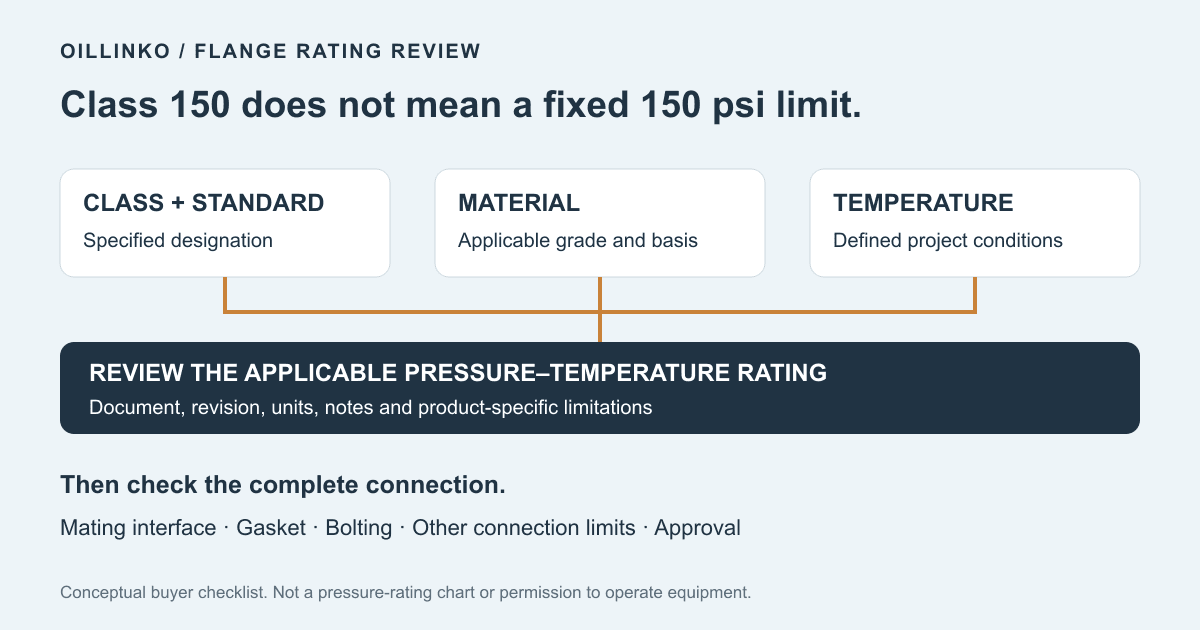
The flange pressure class buyer guide explains why a class number is not a fixed pressure value. It connects material and temperature information to the rating review, then checks the evidence needed for the complete mating connection.
Nominal size and pressure class are starting points, not a complete connection definition. The ASME B16.5 scope covers pressure-temperature ratings, materials, dimensions and other requirements for the flanges and flanged fittings within its scope. A class designation is not a single allowable pressure for every temperature and material. The responsible engineer needs to confirm the rating against the project conditions, and the supplier needs enough information to identify the correct component and supporting documentation.
Facing, bore, end preparation and connection standard affect fit even when nominal sizes match. Existing drawings are particularly useful where replacement parts must connect to installed equipment. The article on flanges, gaskets and bolting explains why these items are specified as a joint system. Avoid ordering each element from a different shorthand description and expecting the final assembly to be compatible. Where flange standards or connection systems differ, request an engineered interface review rather than assuming that a nominal size conversion will resolve the difference.
Separate geometry from material requirements
Pipe schedule describes a wall thickness designation within an applicable dimensional system. It does not by itself establish material grade, corrosion allowance, manufacturing route or the pressure capability of a completed piping system. The pipeline fittings and schedules article is useful for preparing elbows, tees and reducers as clear line items. Include fitting type, dimensions, material specification, end preparation and required records. If a drawing controls the item, identify its revision so a supplier does not price a standard catalogue fitting against a custom geometry.
Material compatibility must consider the wetted and non-wetted parts that matter to the application. A valve body and its trim may use different materials, while a gasket can combine filler, winding and ring materials. Fastener grade and coating may also be relevant to the joint environment. Provide the approved material specification and actual service conditions instead of requesting a general stainless steel or chemical resistant product. The materials documentation guide explains how heat or batch identification and inspection records support the traceability of the supplied components.
Specify bolting and joint accessories
Bolting enquiries should identify the fastener type, diameter, length, thread and specified material grade. Nuts, washers and coatings may have separate requirements and should be described explicitly when included. A count of bolt sets can be ambiguous unless the contents of each set are defined. Use the joint schedule or approved drawing to establish quantities and dimensions, and ask the supplier to identify deviations from the requested construction. Do not infer a suitable bolt length or material from pressure class alone, because the complete joint arrangement and project specification determine the requirement.
Sealing products require the same level of identification. A gasket that looks similar in a photograph can have a different thickness, construction or material combination. Existing equipment may also use proprietary sealing elements that cannot be substituted from nominal dimensions alone. The gaskets and sealing products article explains the information useful for sourcing. Installation loads, tightening methods and reuse decisions must follow the approved joint procedure and product instructions. A procurement discussion should collect those requirements, rather than inventing a torque value or a universal assembly method.
Request evidence that matches the order
Inspection and documentation requirements should identify what needs to be demonstrated for each product. Material records, dimensional checks, pressure tests and valve seat leakage tests are different forms of evidence. State the applicable standard and acceptance criteria where your project requires them, and ask suppliers to list any exclusions. If a third-party witness is needed, arrange the scope and notification points before manufacture reaches that stage. The inspection and maintenance guide helps translate a broad request for certification into a defined inspection activity and deliverable.
For a mixed piping enquiry, organize line items by the actual product rather than combining several components into an ambiguous description. Specify quantities and units, and mark which accessories are included in each assembly. Use the valve catalogue and flanges, fittings and bolting catalogue to frame the requirement sent to Oillinko. Keeping the technical description, drawings and agreed deviations together makes it easier to compare quotations and to verify that delivered items correspond to the final purchase scope.
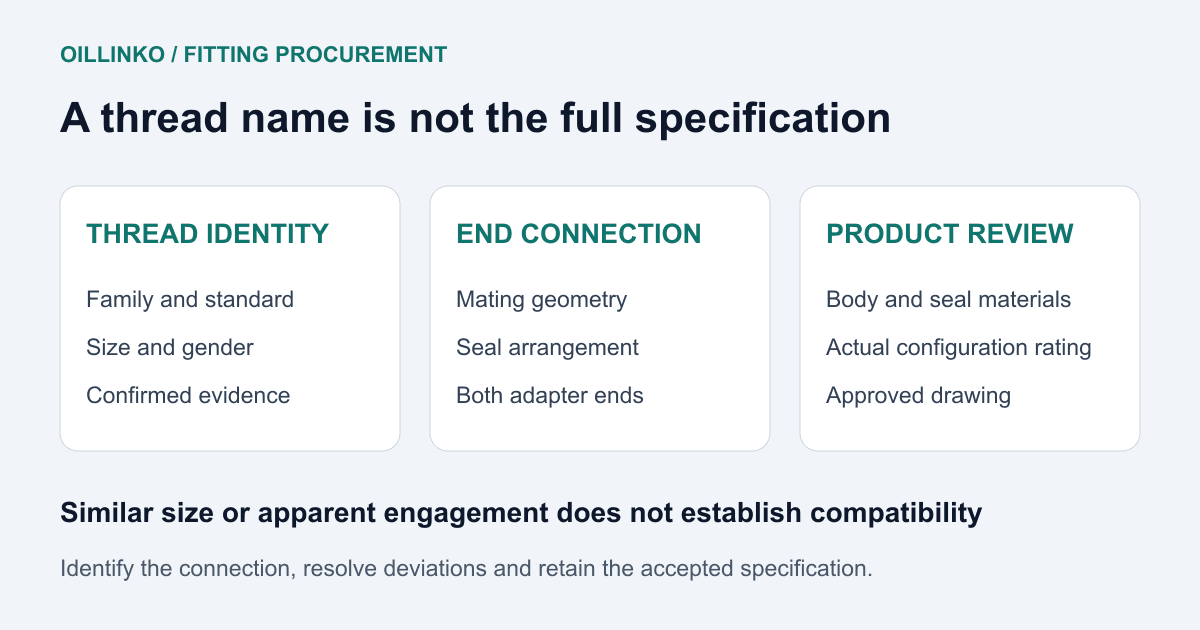
Specify threaded connections completely
The NPT, BSPT and BSPP buyer guide separates thread identity from the complete mating and sealing arrangement. It explains what to record for each end of an adapter, how to handle uncertain samples and why the actual product configuration needs its own material and rating review.
Articles in Piping, Flanges & Fittings
· 8 min read
NPT vs BSPT vs BSPP: A Threaded Fitting Buyer’s Guide
Identify the thread family and complete sealing arrangement before ordering fittings or adapters.
Read article →
· 9 min read
ASME B16.5 Flange Pressure Classes: A Buyer’s Guide
Understand class designations, material-specific pressure-temperature ratings and complete-joint checks before buying flanges.
Read article →
· 6 min read
Pipeline Fittings & Schedules
Elbows, tees, reducers and how schedules work
Read article →

· 8 min read
Flanges, Gaskets & Bolting
How flanged connections hold, and how to spec them
Read article →